A pretty windy one today, started very well. I stepped out the back door this morning to take the dogs on their walk and looked up to see a Green Sandpiper flying over the back garden! This is only the second time I've seen the species over the garden, the last (and first) was only a month ago.
I guess there is some potential that it's the same bird that's moving around the ditches in the local farmland, alternatively it could quite easily be another migrant given the time of year.
The day didn't really get any better as I was stuck in the office, however given the windy conditions I probably didn't miss too much! I didn't make the harrier roost tonight but heard that between 10 and 14 birds were potentially in the area. Will take another look tomorrow.
Hoping the wind dies down overnight so I can make the most of tomorrow and do some local birding, however I may be tempted to the coast if the conditions improve!
Friday, 14 September 2012


Thursday, 13 September 2012
Harrier Roost: NDC
100 followers! Result!
Another very interesting evening down at North Duffield watching the harriers coming in to roost. The weather was not great and it was dark a good 30/40 minutes earlier than Tuesday. As a result the harriers appeared to come in a fair bit earlier. I'd estimate between 13 and 16 birds tonight, there was at least 5 males of various ages, 1 adult female and the rest a load of juveniles, some dark, some light.
Another very interesting evening down at North Duffield watching the harriers coming in to roost. The weather was not great and it was dark a good 30/40 minutes earlier than Tuesday. As a result the harriers appeared to come in a fair bit earlier. I'd estimate between 13 and 16 birds tonight, there was at least 5 males of various ages, 1 adult female and the rest a load of juveniles, some dark, some light.
A merlin shot through at about 1900hrs and 10 Lapwing flew south along the river. Good times!
Just as exciting, I've booked up for my Scillies trip in October. Dave and I are going to be seeing if we can beat last years totals...Northern Waterthrush, Scarlet Tanager, Red-eyed Vireo, Solitary Sandpiper, Upland Sandpiper, Wilsons Snipe, Olive-backed Pipit, Red-throated Pipit, Melodious Warbler, Black Kite, Woodchat, Wryneck, Bluethroat to name a few...
Just as exciting, I've booked up for my Scillies trip in October. Dave and I are going to be seeing if we can beat last years totals...Northern Waterthrush, Scarlet Tanager, Red-eyed Vireo, Solitary Sandpiper, Upland Sandpiper, Wilsons Snipe, Olive-backed Pipit, Red-throated Pipit, Melodious Warbler, Black Kite, Woodchat, Wryneck, Bluethroat to name a few...
Wednesday, 12 September 2012
Raptors Keep On Coming...
Had a busy day in the office today but my dog walk this morning was great, clear and obvious Meadow Pipit passage with the odd Yellow Wagtail in with them, also plenty of hirundines heading south. A flock of 8 Lesser Redpoll zipping through was cool, though my attention was soon pulled away and skywards as I picked up 2 Hobbies (an adult and a juvenile) coming together right overhead. It was almost as if they spoke to each other as after a short time together they formed a pincer movement and shot off into the sun, presumably to nail one of the aforementioned species! For the first time since about late-July it felt freezing this morning, however this didn't stop at least 3 Chiffchaff singing, maybe they thought spring had finally arrived?
I didn't get to the roost tonight but heard at least 7 birds were present early on (before the roost watch was aborted for something more interesting - to the year-listers!).
We had some really heavy rain showers this afternoon so it will be interesting to see if it has dropped anything of interest tomorrow. I'll be doing the roost tomorrow night so looking forward to some more harrier action!
Tuesday, 11 September 2012
WOW! What a night! Raptor Central in the LDV
After Sunday night at North Duffield I decided to go back and check out the roost to see what was going on. I got into the Geoff Smith hide at about 1715hrs (and met a really nice gentleman) and it wasn't long before the Marsh Harriers started to appear... from all directions! More on these later... but first the other birds which were not half bad either! It was a good evening in the hide with Tim, Jack and Elaine all helping make the counting a bit easier than when I was sat in the hide on my own the other night! We finished off about 2010hrs. Tim got some good pictures too so worth checking out his blog too.
2 x Merlin: A juvenile/female hunting flew straight towards the hide and an adult male seen hunting over the north part of the reserve an hour or so later;
2 x Hobby: A juvenile seen with a kill about 1730 as it flew low towards the village and an adult seen hunting to the right of the hide towards Aughton;
c.500+ Swallow/House Martin hawking over the whole reserve (may be an under-estimation as there was loads of them!);
2 x Wheatear sat on straw bales;
c.100+ Meadow Pipit/Yellow Wagtail flew in from the east towards my wagtail field;
1 x Woodcock flushed by a tractor from Bubwith side;
2 x Snipe flushed by Marsh Harriers; and
2 x Barn Owl (one near hide and one in north).
So how many Marsh Harriers? Well I'd go for at least 11 tonight that roosted, with 2/3 others that may have just carried on through the site. There was at least 2 distinctively plumaged/birds in moult that were present on Sunday that were not recorded tonight. It became quite difficult to count the birds near the end as the farmer came out twice with his tractor which resulted in some/most of the birds being flushed and them moving around a fair bit. However we were all fairly happy with the following:
1 x adult female;
4 x 2nd/3rd year males (variable amounts of grey in tail including 3 males all in the air together); and
6 x juveniles.

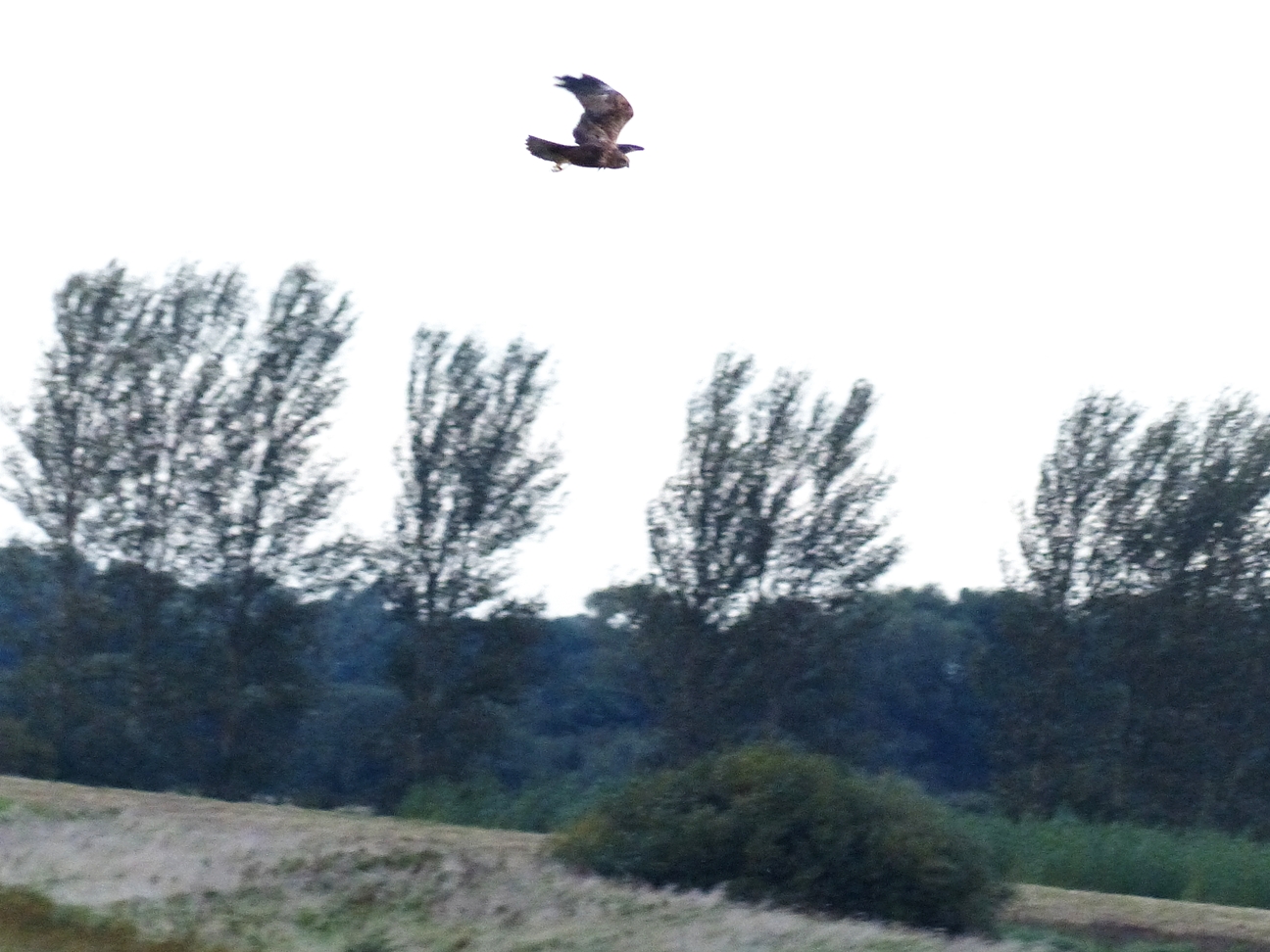


Tree Pipit
Just remembered I had a Tree Pipit over when I was walking the dog yesterday, totally forgot about it until Tim just messaged to say he and Jack had had one over North Duffield this am.... more to follow later!
Walk this morning was good, felt like autumn rather than an Indian summer like the last couple of mornings. Had a flock of 25 Lapwing NW, 3 Snipe S and flocks of 45 Goldfinch and 60-80 mixed Swallow and House Martin all swarming about and a couple of Meadow Pipit and Yellow Wagtail south.
Looking forward to the Harriers tonight...

Alfie and Daisy enjoying the morning walk
Sunday, 9 September 2012
Marsh Harrier Roost: North Duffield Carrs
After yesterdays trip out I seem to have got a bit of my desire back. Unfortunately there was very few Yellow Wagtail or Meadow Pipit around but there still appeared to be a few Swallow going south. Highlight was a cracking juvenile Marsh Harrier that flew very low right overhead giving super views.
It was another really hot day so the middle of it was spent lounging in the garden, again more Swallow passed south with the odd Yellow Wagtail and Tree Sparrow too.
I decided to go sit in the Geoff Smith hide down at North Duffield Carrs this evening to see if there was much doing with the roosting Marsh Harriers. I wasn't disappointed! I'd heard that 8 birds had roosted down there on Thursday night which would be a local area 'gathering' record I hear.
I got to the hide about 1830. The last entry for the notebook was 1730. 3 Marsh Harrier. It didn't give any specifics regarding age/sex, however on my arrival there was none to be seen, had they already gone to roost? It didn't take long for the party to get going and it lasted just over an hour. It started at 1845 when the first bird appeared, and finished at 1949 when the last one dropped out of view. I gave it another 20 minutes but nothing else appeared.
So how many.... well I'd estimate at least 8-10 roosted, and at least 1 juvenile went straight through (and what about the 3 that were there before I got there? There was a good mix of ages and sexes and it was interesting to watch their behaviour. For example an adult male flew straight into the central field and dropped straight in to roost. It wasn't seen again. Several of the young (2nd year birds)/females perched up on fenceposts and sat and surveyed their surroundings before dropping in to roost and the juvenile birds - looking really smart and bright moved around a lot before settling down.
There wasn't too much else doing several geese flocks distantly, looked more like Greylag than anything more exciting. Several groups of Swallow flew south and the odd Yellow Wagtail did likewise. Two Buzzard and a Kestrel showed well.
It will be interesting to keep an eye out on this harrier roost (until the field gets cut!), fingers crossed it pulls in a Hen Harrier (or better)...

View out of the hide this evening
Saturday, 8 September 2012
I actually went birding!
A shock I know. Had to find my optics as it's been a while! Just lost the desire over the last few months, too many other things going on.
Anyway, I decided to take a trip around the local patch. For the morning dog walk I decided to take a different route, this proved a good choice as I came across a field with at least 25 Yellow Wagtail present. I hung around for a bit and had loads of Goldfinch, Linnet and about 30 Meadow Pipit. Quite a few Swallow were heading south. I hoped for something better, but no joy and it was starting to get hot so I headed back home. Had a male Sparrowhawk drop in with its breakfast - a young Blackbird, and the local Kestrel was busy flushing the wagtails.
It was surprisingly hot so I spent the afternoon sat in the garden, kind of working, kind of keeping an eye on the sky. There was loads of hirundines over the house, presumably a mix of the local breeding birds and some migrants as the Swallows just seemed to be going south. A Buzzard caught my eye high in the sky, then another, then another couple even higher. All four birds drifted south at quite some height. Several Meadow Pipit and Yellow Wagtails could be heard as they also passed south. Quite a lot of Lesser Black-backed Gulls were moving about, as they have been doing over recent days, one bird caught my eye as it looked real good for Yellow-legged Gull. There's been a few in the local gull flock that has been in the fields so chances are fairly high as they move around. Not happy with the brevity of the views so want more to be 100% satisfied!
Late afternoon/early evening I decided to go down to North Duffield Carrs, for about the first time since about May (I've really been that busy!). Had 4 Marsh Harriers flying about - there had been 8 birds roost the other night, which, apparently is a local area record. Otherwise is was fairly quite with the odd Swallow, Yellow Wagtail and Meadow Pipit heading south along the river. Still lots of dragonflies shooting about the place too. A flock of five disant geese disappeared, too early for Pink-feet???
I decided to check the wagtail field again, most of them cleared off as I approached, at least 32 Yellow Wagtail and a number of Meadow Pipit, was bad viewing as I was looking straight into the sun. Highlight however was a smart autumn plumage Wheatear sat on a straw bale. The Sparrowhawk and Kestrel were still hanging round too! Hopefully I'll check out the area in the morning when the light might be better.
Saturday, 25 August 2012
Gull-billed Tern at Tophill Low, East Yorks
Gull-billed Tern this afternoon at Tophill Low - check out Rich's pics on the Tophill Blog later this evening. Bird may well have cleared off but is being looked for.
Friday, 17 August 2012
RN Phalarope Local MEGA!
Unfortunately this afternoon there was the second ever Red-necked Phalarope for the York Area over at Bank Island in the LDV, a great find by Craig and the LDV team. It was 'unfortunately' as I was stuck in the York office all day so had no change of going straight across, if only it was yesterday when I was working from home! A quick call in on my way home showed plenty of birds on the new mud but not the desired species!
Apparently the last one was 1984 and was single observer, hopefully this will get re-found but it's not looking good so far!
Apparently the last one was 1984 and was single observer, hopefully this will get re-found but it's not looking good so far!
Wednesday, 15 August 2012
Hudsonian Whimbrel coming to the UK soon...
maybe....
Some interesting research coming out of the US over the last couple of day. If you've seen my blog before you may have seen some of the information on Whimbrel ringing that been going on at my local patch (Lower Derwent Valley SPA) over recent years. This has provided some really useful information - see for example here.
Just as interesting is the work going on in Canada regarding Hudsonian Whimbrel, which shows birds flying 2,500 miles out into the Atlantic on their southbound autumn migration, and the possibility of vagrancy to the UK... This from the Centre for Conservation Biology, College of William and Mary – Virginia Commonwealth University
Scientists at the Center for Conservation Biology (CCB) have tracked 3 whimbrels off the east coast of Canada to the northern shore of South America via a previously unknown migration pathway over the open Atlantic Ocean. The route passed through the center of the vast Atlantic at one point passing 1,000 miles closer to Africa than to North America and within 700 miles of the Cape Verde Islands. The bird with the longest flight flew nonstop for 145 hours (6 days) covering a distance of 7,000 kilometers (4,355 miles).

The three birds named Mackenzie, Taglu, and Akpik were originally marked by CCB and Canadian Wildlife Service staff on the breeding grounds along the Mackenzie River Delta in far western Canada (Mackenzie was fitted with a transmitter recovered from Machi, a bird that was shot on Guadeloupe in September of 2011). In mid-July the birds flew across the continent to the east coast of Canada and staged for approximately 2 weeks in the James Bay and the Gulf of St. Lawrence to build fat reserves. The birds then flew southeast, reaching the center of the Atlantic Ocean before turning south and making landfall in South America between Guyana and Brazil. Although this portion of the Atlantic is used by true seabirds that roost on the water, it is so isolated from shore that species such as whimbrel that cannot land on water were not believed to reach it. The birds may receive some benefit from venturing this far out to sea in the form of
favorable tailwinds. Mackenzie averaged just under 30 miles per hour (48 kilometers per hour) for the 6-day flight.
The three birds are part of a larger project that has included 20 additional birds that have been tracked to better understand migratory pathways and locations that are critical for this declining species. The study has tracked whimbrels for more than 185,000 miles (300,000 kilometers) since 2008. The broader tracking project is a collaborative effort between The Center for Conservation Biology, The Canadian Wildlife Service, The Nature Conservancy, The U.S. Fish and Wildlife Service, Georgia Department of Natural Resources, the Virginia Coastal Zone Management Program, and Manomet Center for Conservation Sciences.

Some interesting research coming out of the US over the last couple of day. If you've seen my blog before you may have seen some of the information on Whimbrel ringing that been going on at my local patch (Lower Derwent Valley SPA) over recent years. This has provided some really useful information - see for example here.
Just as interesting is the work going on in Canada regarding Hudsonian Whimbrel, which shows birds flying 2,500 miles out into the Atlantic on their southbound autumn migration, and the possibility of vagrancy to the UK... This from the Centre for Conservation Biology, College of William and Mary – Virginia Commonwealth University
Scientists at the Center for Conservation Biology (CCB) have tracked 3 whimbrels off the east coast of Canada to the northern shore of South America via a previously unknown migration pathway over the open Atlantic Ocean. The route passed through the center of the vast Atlantic at one point passing 1,000 miles closer to Africa than to North America and within 700 miles of the Cape Verde Islands. The bird with the longest flight flew nonstop for 145 hours (6 days) covering a distance of 7,000 kilometers (4,355 miles).

Fletcher Smith with Akpik on breeding ground in the Canadian Arctic.
The three birds named Mackenzie, Taglu, and Akpik were originally marked by CCB and Canadian Wildlife Service staff on the breeding grounds along the Mackenzie River Delta in far western Canada (Mackenzie was fitted with a transmitter recovered from Machi, a bird that was shot on Guadeloupe in September of 2011). In mid-July the birds flew across the continent to the east coast of Canada and staged for approximately 2 weeks in the James Bay and the Gulf of St. Lawrence to build fat reserves. The birds then flew southeast, reaching the center of the Atlantic Ocean before turning south and making landfall in South America between Guyana and Brazil. Although this portion of the Atlantic is used by true seabirds that roost on the water, it is so isolated from shore that species such as whimbrel that cannot land on water were not believed to reach it. The birds may receive some benefit from venturing this far out to sea in the form of
favorable tailwinds. Mackenzie averaged just under 30 miles per hour (48 kilometers per hour) for the 6-day flight.
The three birds are part of a larger project that has included 20 additional birds that have been tracked to better understand migratory pathways and locations that are critical for this declining species. The study has tracked whimbrels for more than 185,000 miles (300,000 kilometers) since 2008. The broader tracking project is a collaborative effort between The Center for Conservation Biology, The Canadian Wildlife Service, The Nature Conservancy, The U.S. Fish and Wildlife Service, Georgia Department of Natural Resources, the Virginia Coastal Zone Management Program, and Manomet Center for Conservation Sciences.

Map of migration route for 3 whimbrels marked on breeding ground in western Canada.
Incredible flight through the open Atlantic was previously undocumented.
Monday, 30 July 2012
Garganey in the hand!
Today I got the very rare opportunity to take a look at a Garganey that was trapped and ringed at Wheldrake Ings NNR this evening. Some pictures below. Also a Teal was trapped too. Great to be able to compare head patterns. Both birds were colour-ringed as par of the really interesting ongoing project in the valley. Garganey yellow on left and right, Teal orange on left and right. Expect some more details/better pictures on the LDV blog soon. Pics below are off phone cameras so not the best, but at least you can tell what it is!


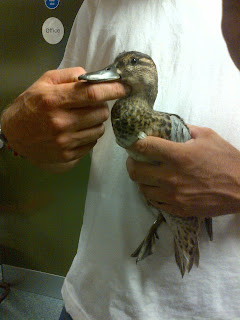


Garganey (Russell Slack)

Garganey (Andy Walker)

Garganey (Andy Walker)

Garganey (Andy Walker) - check out the giant tertials!

Garganey (Russell Slack)

Garganey and Teal (Russell Slack) - surprisingly subtle head patterning in eclipse

Garganey (Andy Walker)
Friday, 13 July 2012
Gropper on the Patch
Yesterday morning while walking the dogs I had a few bursts of Grasshopper Warbler song, interestingly in the same area I had a male singing on one morning (only) about 2 months back. It was still present and a lot more vocal this morning. They seem fairly thin on the ground in the recording area this year, compared to last year at least when there seemed to be quite a few around. Indeed, one of the York Year Listers Elite Team twitched it for his year list.
Sunday, 8 July 2012
A Bit of Nest Finding
Went out this afternoon to have a look at some birds on the edge of York. Was very pleased to see that 3 Ringed Plover chicks I've been watching for the last few weeks have managed to survive the dogs/foxes/stoats/crows/sparrowhawk/kestrels etc. on the site and have fledged - a great result. Just as pleasing was finding another pair that had 3 small chicks, estimated at being about 10 days old, topped further by the discovery of a nest containing two recently hatched chicks with a third bird stood just out of the nest.


Also present were 3 Oystercatcher that had successfully fledged from the same site a few weeks ago.
A fairly interesting discovery involved a pair of Pied Wagtail. I found these birds nesting in a skip a month or so back, maybe 2 months. They successfully fledged several young. Then they had a second brood in the same nest. Again they fledged several young. I went back to check the nest this week to see if there were any dead young or if they'd gone for a third brood, but there was no sign and the nest was empty. I decided to check out the rest of the skip, just in case, and to my surprise discovered another nest, complete with Pied Wagtail sat in it! Presumably the same pair having at least their third brood!

On Saturday I went for a local walk in between the rain showers, was nice to see lots of butterflies (Meadow Brown, Large Skipper, Red Admiral and Ringlet) and the odd big dragonfly too. Got a Cuckoo, Green Woodpecker, Great Spotted Woodpecker and a few other bits and pieces, lots of warbler singing too including Garden Warbler, Blackcap, Common Whitethroat, Chiffchaff and Willow Warbler.


Ringo Nest

1 of 3 Ringo Fledglings
Also present were 3 Oystercatcher that had successfully fledged from the same site a few weeks ago.
A fairly interesting discovery involved a pair of Pied Wagtail. I found these birds nesting in a skip a month or so back, maybe 2 months. They successfully fledged several young. Then they had a second brood in the same nest. Again they fledged several young. I went back to check the nest this week to see if there were any dead young or if they'd gone for a third brood, but there was no sign and the nest was empty. I decided to check out the rest of the skip, just in case, and to my surprise discovered another nest, complete with Pied Wagtail sat in it! Presumably the same pair having at least their third brood!

3rd brood Pied Wagtail
On Saturday I went for a local walk in between the rain showers, was nice to see lots of butterflies (Meadow Brown, Large Skipper, Red Admiral and Ringlet) and the odd big dragonfly too. Got a Cuckoo, Green Woodpecker, Great Spotted Woodpecker and a few other bits and pieces, lots of warbler singing too including Garden Warbler, Blackcap, Common Whitethroat, Chiffchaff and Willow Warbler.


Friday, 6 July 2012
Quail on the Wolds...
Not last night it wasn't!
Went back to a site where we had loads of Quail on the Yorkshire Wolds last year, and where we had one earlier in the 'summer', but last night there was not a peep unfortunately.
Not done any birding for what feels like an age, the last few weeks have been taken up by tonnes of report writing. Hopefully got a good trip planned for next week if weather holds.
Sunday, 1 July 2012
Autumn Passage is on!
Had a busy week last week which involved a lot of report writing and even some maths in the form of Population Viability Modelling, so birding was pretty much on the back-burner. I did manage however to hear Green Woodpecker from the garden again. Last week I had a single Common Sandpiper on a small pool on the outskirts of York while looking for Sacred Ibis (no joy with the Ibis) which I thought was a sign of Autumn. (also had a Hobby here).
Yesterday Tim said that he'd had the first Green Sandpiper of the Autumn at Hes East so I thought I'd take a look this morning to see if there was anything else about. The Green Sandpiper was still present (see phone-scoped photo below) but more interestingly was the flock of (at least) 7 Common Sandpiper that were present along the main lake. There could have been more as they were moving into vegetation to roost and were difficult to count at times, but the maximum I had out in the open at any one time was 7!
I'd be interested to hear what the largest flock of Common Sandpiper is in the York area - wonder if this flock breaks the record? (if there is one!)

Green Sandpiper (Phone-scoped)

Green Sandpiper (Phone-scoped)
Will be interesting to see what else gets turned up at the site over the Autumn months...
Subscribe to:
Posts (Atom)