Showing posts with label Birding Ecotours Australia Trip. Show all posts

Tuesday, 19 September 2017

Eastern Australia Highlights

I'm currently about to fly from Adelaide to Brisbane to head off on another Outback adventure, this time through Queensland (and probably dropping into northeastern South Australia again, maybe even New South Wales!). Got a few specific targets in mind and looking forward to seeing some more of this wonderful country.

However, I'm still playing catch-up on my blog so here is a brief summary of my Australia trip from late last year - the trip report that I wrote for this Birding Ecotours trip can be found here: http://birdingecotours.com/trip-reports/australia (October-November 2016).

On this trip I visited Victoria, a brief stop in New South Wales, Queensland (north and south), and then finished up in Tasmania. I've covered these areas a few times now and it's nice to go back to places I'm familiar with and to see the same birds again, as well as get the odd different and new one (be that a lifer, year tick, or even a state bird - keeps it interesting!)... There are so many incredible birds in Australia it's difficult to know where to start.

Below I've included some some photos and notes on some of my highlights (that I managed photos of), of course there were many more I didn't get chance to photograph (refer to the actual trip report for more detail). Hopefully the below will give a good selection of Aussie birds and birding.

Beautiful Firetail is just that, beautiful, and more. A really stunning birds and this year I got my best ever views and photos of it whilst in Tasmania.

Orange-bellied Parrot - one of the rarest birds in the world. Unfortunately as each year passes this species falls closer and closer to extinction (at least as a viable wild population). There are projects underway to help save this species, and I really hope they are a success. I really love this gorgeous little parrot.

Plains-wanderer is one strange bird. Its closest relatives are the Seedsnipes of South America (I'll mention those again when I get round to writing my Peru report!). It's always a very satisfying moment when we see the Plains-wanderer as there is a lot of habitat and not that many birds about, and it's night time too! Think needle in a dark haystack!

Blue-faced Parrotfinch is one of the most-difficult of the Atherton Tablelands/Mount Lewis birds and finally we caught up with some - this was the highlight of my birthday - my third in a row in Australia, this year I'll be somewhere else for my birthday (hint somewhere below!). 

Australian Golden Whistler is a common bird, but it looks stunning and it has a very nice song so it's always nice to re-familiarize myself with this one.  

The Willie Wagtail is a very common bird found throughout most of Australia, here it shows its don't-mess-with-me attitude in mobbing and Australian Hobby!

Black-eared Cuckoo can sometimes be a pain to catch up with so I was very pleased when we got this bird very early on in the tour, and it actually probably ended up being my best views yet.

Buff-breasted Paradise-Kingfisher is a must-see bird when birding in tropical north Queensland and we did not leave disappointed with some great views of several birds just arrived from New Guinea (Hint my birthday this year will be spent hopefully enjoying some different Paradise-Kingfishers). 

The odd-looking (I think) Cape Barren Goose is an interesting bird and one I enjoy finding whist in southern Australia.

My favourite of the many sub-species of Crimson Rosella this one was down in Victoria and showed remarkably well - a phone-scoped photo taken on my IPhone 5 and Swarovski ATX-95 scope.

Endemic to Tasmania, with a tiny global distribution, the cute little Forty-spotted Pardalote is always a great bird to find.

Not a great photo I know, but this is Glossy Black Cockatoo which is actually very rare and was a lifer for me.
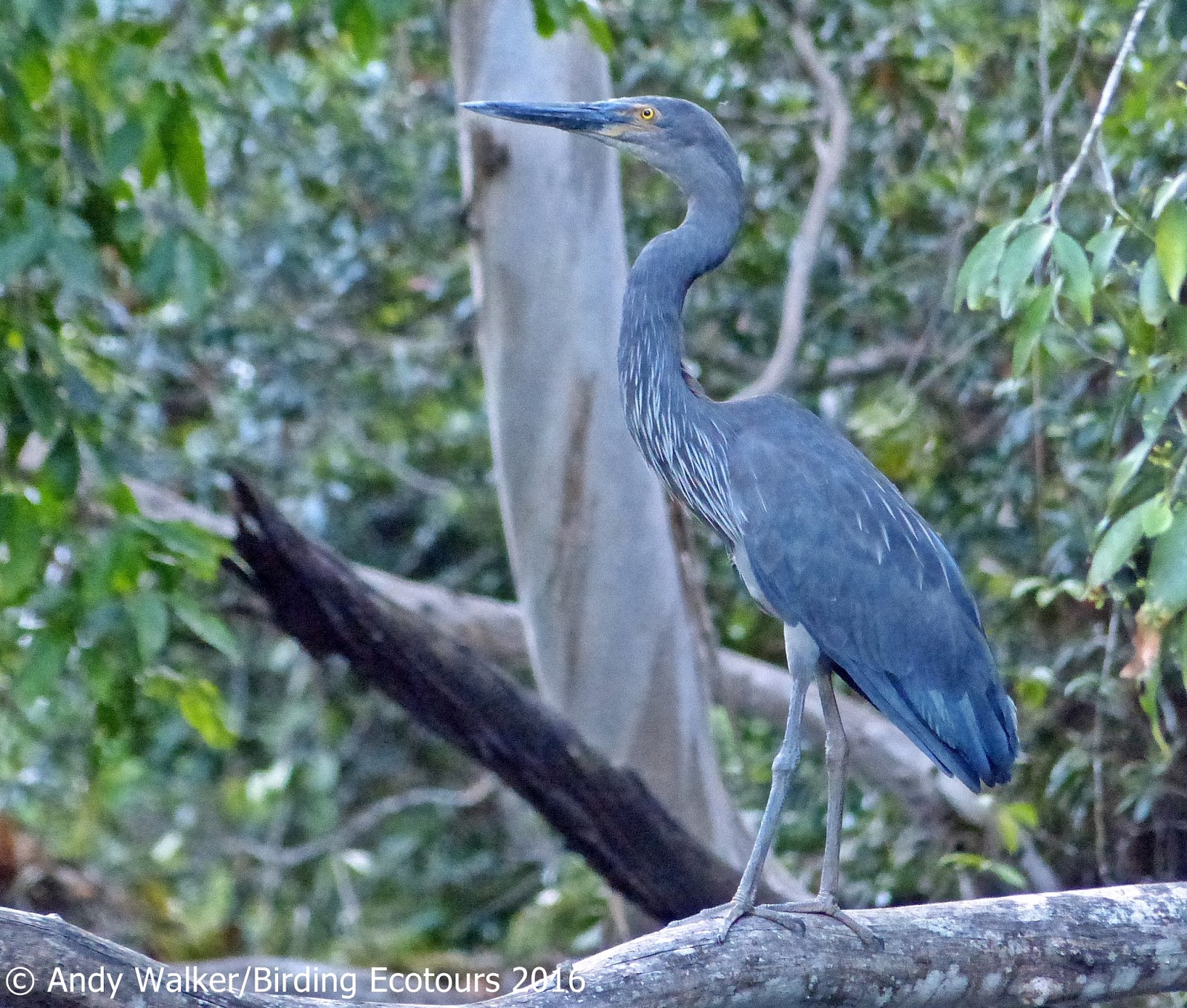
This beast is one of the largest herons in the world, is fairly rare and is best seen in tropical north Queensland, Great-billed Heron.

The Hooded Plover or Hooded Dotterel is an Endangered endemic shorebird found around Australia's coasts. Unfortunately, due to their breeding habitat requirements this puts them in direct competition with many thousands of Australians who also spend a lot of time enjoying the beaches right at the time the plover is nesting.... this species needs more protection. 

Laughing Kookaburra - THE sound of Australia. I love these giant kingfishers!

It is always nice to see a buttonquail and on this day I saw at least three of these Little Buttonquails!

Found this one in Queensland, I'm gradually getting to a place where I'm happy with this photo, but just too much 'stuff' in the way - maybe tomorrow...

Russet-tailed Thrush is one great bird, especially when I found the nest of one (below). We got insane close-up views of this bird feeding away, totally not bothered with us looking at it!

Russet-tailed Thrush on nest in Queensland

Satin Bowerbird - always delivers great views

Often considered one of the most difficult of the Tasmanian endemics to catch up with we again had fantastic views of them (difficult to photograph though in the dark forested gullies they live in!).

Sooty Oystercatcher - a really smart shorebird!

This Spotted Harrier was hunting along a sidetrack off a main road in Queensland, great timing allowed me to pull off and then it dropped down to the ground right near the vehicle. Took this pic through the window as didn't want to flush it/waste time!  

Spotted Pardalotes are common birds and very photogenic, one of my favourite birds in Australia.

Superb Fairywrens are very common birds but I've never got a decent picture of them, I'm getting pleased with this one, but still got a long way to go until I'll be totally happy...


AND FINALLY..... Australian Robins are gorgeous birds, here's a few to end this post but look back soon for my Western Australia post (so many cool birds there!):

Pink Robin from Tasmania where this species showed well. 

Eastern Yellow Robin

Flame Robin

Red-capped Robin

Scarlet Robin

Friday, 22 July 2016

Big Australia Trip Coming Soon!

Really excited to have a birding tour along the East Coast of Australia this October and November. We'll be birding in Victoria, New South Wales (just over the border) and in south, then North Queensland. Last years tour resulted in some incredible birds seen

I'll also probably be spending time in Tasmania, South Australia, Western Australia and hopefully the Top End too - I'll be scoping out new areas for upcoming Birding Ecotours trips.

Really looking forward to have another in-depth look at what is quickly becoming my favourite wildlife-watching destination on the planet.

During the three-week tour we'll be looking for some quality birds, such as Plains-wanderer, Mallee Emu-wren, Malleefowl, Superb Lyrebird, Southern Cassowary, Great-billed Heron, Golden Bowerbird, Regent Bowerbird, Victoria's Riflebird, Buff-breasted Paradise-Kingfisher, Hooded Plover, Inland Dotterel, Major Mitchell's Cockatoo, Superb Parrot, and so much more!

Last years tour recorded 416 species of birds, 42 mammals, 19 reptiles, and 10 amphibians. with standout mammals being Koala, Platypus, Short-beaked Echidna, Red Kangaroo and Common Wombat.

There are a couple of places still available on the tour. If you're interested, or know of anyone who might be interested please click this link for tour details. CLICK HERE.

Plains-wanderer - always a highlight and this female showed so well for our group last year.

Southern Cassowary - my favourite bird on the planet and another star bird that performed well during last years tour. Here the adult male with his two chicks.

ALL THE AUSTRALIA TOURS CAN BE FOUND HERE: http://birdingecotours.com/tours/destination/country/australia 

The Australia 2015 Trip Report can also be found here:

After the tours I'm aiming to spend time in the Perth area of Western Australia where I'll be targeting the nearly 20 or so regionally endemic species such as Carnaby's and Baudin's Black Cockatoos, Western Corella, Red-capped Parrot, Western Rosella, Noisy Scrub-bird, Western Bristlebird, Red-winged Fairywren, Western Fieldwren, Western Thornbill, Western Wattlebird, Western Spinebill, Gilbert's Honeyeater, White-breasted Robin, Western Whistler and Red-eared Firetail. Also looking forward to some new and exciting mammals and reptiles.

If I get to the Top End (in the Northern Territory), I'll be looking for Rainbow Pitta - need a Pitta fix! But while I'm 'in the area' I'll be looking for Gouldin Finch, Purple-crowned Fairywren, Red Goshawk, Hooded Parrot, Red-collared Lorikeet, Varied Lorikeet, Northern Rosella, Arafura Fantail, Paperbark Flycatcher, Buff-sided Robin, Sandstone Shrike-thrush, Pied Heron, Great-billed Heron, Beach Thick-knee, Chestnut Rail, Rufous Owl, Partridge Pigeon, White-quilled Rock-Pigeon, Banded Fruit-Dove, Little Kingfisher, Long-tailed Finch, White-throated Grasswren, and Black-tailed Treecreeper.

I'm also planning to catch up with my friends Dave and Sue in Adelaide where I'll be looking to add a few new birds to my South Australia list, such as Rock Parrot, and maybe even Western Whipbird, though definitely some more reptiles and mammal - or who knows, maybe I'll even get on a pelagic trip - 3rd time lucky? Grey Falcon might have to wait until 2017...

Before all of this Australia coolness I'll be leading a trip round the Pacific - New Caledonia, Fiji and Samoa, and scoping the North Island of New Zealand - more on that awesome prospect later. My entry into New Caledonia will be from Brisbane so before all of the above fun starts I'll have a few days with my friends Rob and Di in Brisbane and there's a few birds there that I fancy looking for. Masked Owl is high on the target list!

Wednesday, 25 November 2015

Australia Happened (again)

Just back from another awesome trip round Australia (South Australia, Tasmania, Victoria, New South Wales and Queensland). I led a tour for Birding Ecotours and had some free time before and after the tour where I did my own things with my friends in South Australia and Queensland.

Saw a ton of cool birds, including some really rare species, and other highlights included some very rare mammals, reptiles and amphibians. Is it too soon to plan my next trip back there!

Over the next few weeks I'll be putting my trip report online, along with a selection of photos of the above.

Rainbow Lorikeet - an abundant and gaudy parrot


Saturday, 18 July 2015

Australian Bowerbirds and their Bowers

I've been meaning to put this post together for a while now but have not had the time until today. Last year I was lucky enough to spend a month (November) in Australia, and am incredibly excited to be heading back over there again later this year to lead a Birding Ecotours trip. Details of thetrip can be found here (there are a couple of places left). Whilst on the Queensland leg of my previous trip I saw my first ever Bowerbirds (Family: Ptilonorhynchidae). There are currently considered to be 20 species of Bowerbird across New Guinea and Australia, mainly found in rainforest and drier sclerophyll habitats.

Bowerbirds are medium-sized, compact, robust passerines, mostly with stout and powerful bills. They feed on fruit, berries, leaves, insects and invertebrates. The majority of Bowerbirds are incredibly sexually dimorphic. Adult males have strikingly diverse and often colourful plumage, while the females are generally much duller – presumably because the females are the ones responsible for the nesting duties. Males have an incredible vocal range and are great mimics.

Regent Bowerbird © Seabamirum
(Basically Turdus merula with a bit of added yellow!)

Bowerbirds are famous for the construction of bowers where courtship displays and mating take place and this was something I was really keen to observe whilst over there and I didn't leave disappointed! There are two main types of bowers in Australia and I saw samples of both:
  • Avenue bowers: a double avenue of twigs/grass, secured on a platform of sticks on the ground (Satin, Regent, and Great Bowerbirds); and
  • Maypole bowers: tall single or double columns of sticks built around adjacent saplings, and partly filling the gap between them (Golden Bowerbird).

The male bowerbird deposit natural or artificial objects within the bower, these objects are usually of similar colour, or reflectively, to the bill, eyes or plumage of their own species. During display, the bower ‘owner’ frequently pecks at, and moves around the objects, often appearing aggressive towards them, as if they were intruding males! It is thought that the males display at the bower helps stimulate and synchronise the development of the pairs’ sexual organs for successful reproduction.  The bowers also act as a shop window for females to observe males and select the superior bird to pair with (a bit like Manakins lekking in the Neotropics). Male Bowerbirds are polygamous so will mate with a range of females that visit the bower. Females do all of the nest building, incubation and feeding of young.

Whilst at Lamington National Park, southern Queensland I was able to watch a Satin Bowerbird (of the violaceus race) actually attending to its ‘avenue bower’. The Satin Bowerbird is a large (27-33 cm) glossy blue-black bird, with a pale bill and a bright blue eye. He had an area that looked like a bit of a clearing next to a tree fall that formed the backdrop to the bower, there was one tuft of ‘grass’ in front of the branches, the edges of the grass were flattened down and in front of that was an incredible array of bright blue objects that the male had collected and added on top of the flattened down vegetation. Blue bottle tops (drinks bottles including ‘Sprite’, and washing/fabric conditioner types), blue pens, blue plastic sweet wrappers, blue paper, even a blue Oreo packet was identifiable. Basically any blue litter was collected by this bird to decorate his bower! There were a few bluish leaves and flower stems added to give a bit of a natural look to all of the plastic. This was my first ever bower, and I was seriously impressed, but luckily he didn't try to mate with me, though he was making some interesting noises!

Satin Bowerbird (male) © Andy Walker 2014

Satin Bowerbird (male) and its 'Avenue Bower' © Andy Walker 2014

Satin Bowerbird 'Avenue Bower' © Andy Walker 2014

In northern Queensland I had brilliant views of the Great Bowerbird attending its ‘avenue bower’. A bird of the drier habitats it is not as impressive in colouration as the two species above, or some of the ones further down this post, being a mix of greys and browns. It is a large bird, 32-38 cm, with a short, stout bill. What this bird lacks in colour it certainly makes up with its seriously impressive bower – which is huge!  The particular male I came across was busy raiding a vegetable patch at a school yard. He had a taste for chili peppers!

The bower was a classic ‘avenue bower’, and the entrance was a mat of twigs, covered in mainly pale objects such as stones and snail shells, drinks can ring pulls, and with the ubiquitous plastic bottle tops – this time white or clear ones, he even a couple of coins in the mix! A splash of colour was provided in the form of pencil crayons, chili peppers and flowers.

Great Bowerbird (male) © Andy Walker 2014

Great Bowerbird 'Avenue Bower' © Andy Walker 2014

Great Bowerbird 'Avenue Bower' © Andy Walker 2014

One of the other Bowerbirds I was incredibly impressed with in northern Queensland was the Golden Bowerbird – now this one did have some pretty impressive looks, and even more interesting was its vocalisations – a series of rattles, frog-like croaks and mimicry. It made a sound like it was having an electric current passed through it – very odd noises!  As the name suggests this bird (well the male) is golden, with some olive tones on the face and back, and a bright yellow eye. A bird of rainforest, this bird builds a huge vertical ‘maypole bower’. Sometimes up to 3 m tall! The bird I came across had a decent sized bower, it was way over a metre, and looked like it had been there for some time, though I didn't get too close to this one as he seemed a bit skittish and I didn't want to disturb him – hence the grainy/blurry photos taken in the near dark!

Golden Bowerbird © Andy Walker 2014

Golden Bowerbird © Andy Walker 2014

Golden Bowerbird 'Maypole Bower' © Andy Walker 2014

I saw a couple of other Bowerbird species, such as the glow in the dark Regent Bowerbird mentioned right at the beginning of the post, but didn’t get any decent photos of that one. I also saw the Tooth-billed Bowerbird, this one had a bower with an assortment of leaves, all of which were face down on the ground within the bower, exposing their blue-grey underside. But it was quite dark so I didn’t get any decent photos of these etiher.

Tooth-billed Bowerbird © Andy Walker 2014

Also members of the Bowerbird family I had both Green Catbird and Spotted Catbird. Although Bowerbirds, they do not build bowers and males are not polygamous, instead they are monogamous (pair with one female), defend an all-purpose territory and assist with feeding their offspring. They have amazing calls, sounding just like cats – as you’d expect from the name! Green Catbird was busy hiding in the tree tops at Lamington National Park, while Spotted Catbirds were a bit more cooperative and lower in the vegetation around Cairns.

Spotted Bowerbird © Andy Walker 2014

For a chance to come and look for these interesting birds, and many more besides, check out the exciting Birding Ecotours 2015 and 2016 Australia and New Guinea tours here