Tuesday, 1 March 2011

The Sparrowhawk

I went to the York Ornithological Society's illustrated presentation tonight, to a talk on 'The Sparrowhawk' by the author of the Poyser monograph, and world authority on the species, Professor Ian Newton. It was an excellent and highly informative presentation and was a thoroughly enjoyable evening. Maybe more tomorrow...


I also managed to get a couple of my Ian Newton books signed - a good result!

It was good to meet a few more of the local birders too.

Monday, 28 February 2011

Arctic Redpoll - Allerthorpe Common - Got it!

I managed a flying visit to Allerthorpe Common today in order to try and catch up with the Arctic Redpoll that has been giving visiting birders a headache and a half by been fairly elusive at times. My last visit after work on Friday resulted in a small flock of less than 40 Common (Mealy) and Lesser Redpolls but no sign of the Arctic.

Today I walked in from a different angle and picked up a small flock of 30-40 Redpoll feeding along a field margin, before I could start grilling them something flushed everything from the nearby fields and they were up and gone. I decided to walk in the direction they had gone in the hope of relocating them, however after an hour there was still no sign. I bumped into Darren Ward who'd bumped into Ian Andrews who had seen the bird earlier in the morning. At least it was still here, somewhere! We decided to split up in the hope that we'd come across the flock but just as we were about to move off in different directions a flock of well over 100, probably closer to 125 birds flew low over calling.

The birds remained frustratingly flighty and broke up into slightly smaller groups, one such group of about 40 birds flew close in and landed in the heath to feed. After about 10 minutes they flew up into a low, close Silver Birch tree, both Darren and I got straight onto the same bird - it stood out like a sore thumb! It landed facing away, the first thing that stood out was its huge plain white rump and overall pale appearance. Undertail coverts appeared pure white also. As the bird turned its head to preen it had an obviously small bill and was 'bull-necked' with a small red patch on its head. The breast appeared pale (very little/no pink/red) with very fine streaking down the flanks. The bird, along with the remaining birds in the flock dropped back into the heath where they remained feeding (in silence, almost invisible) for almost an hour, providing the occasional tantalising view on the ground and in trees at greater distance.

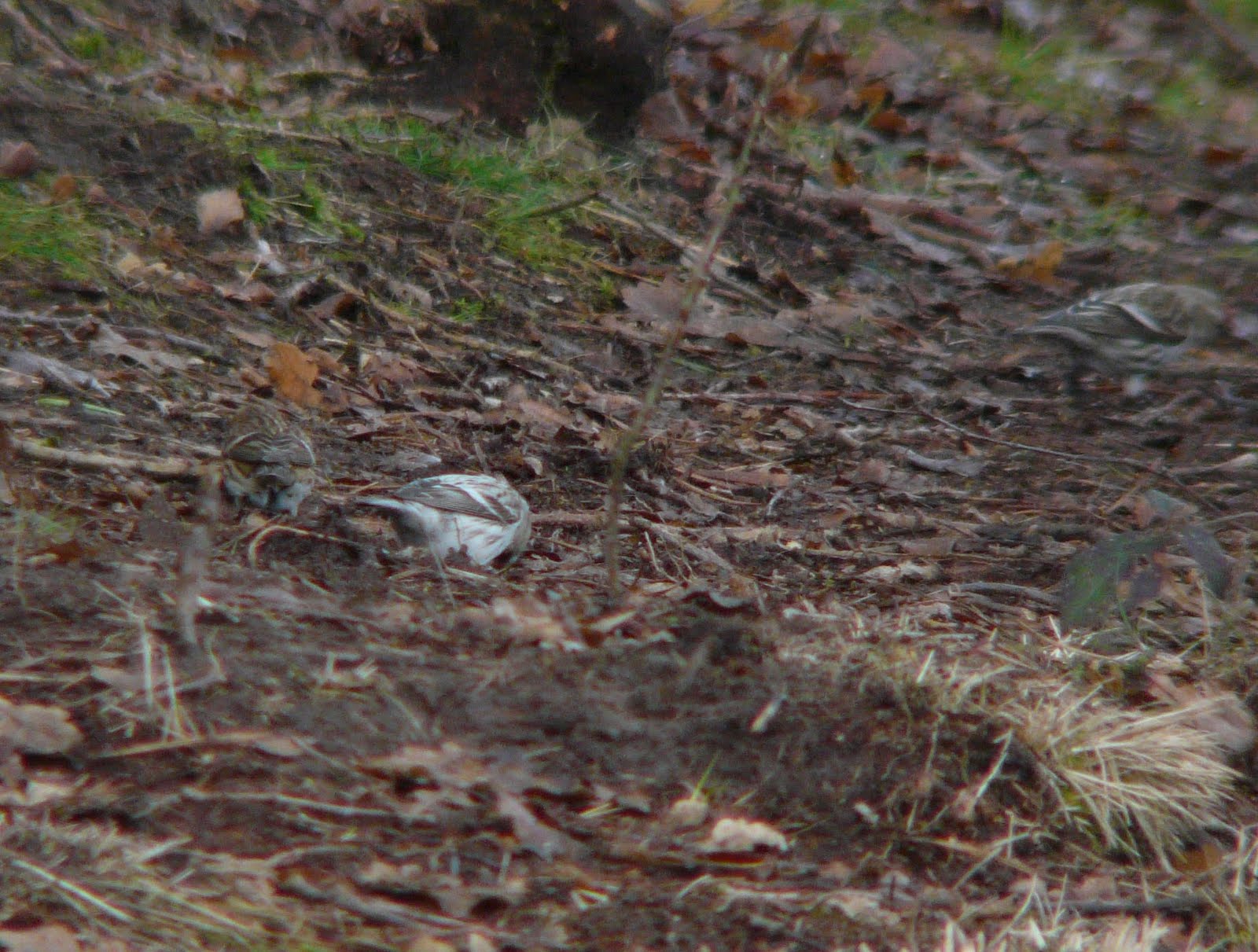
Chris Gomersall has very kindly allowed me to use some of his record shots (below - ALL PHOTOGRAPHS © CHRIS GOMERSALL) from last week. Although not all of the identification features can be observed from these photos they give some idea of what the bird looked like. There was many Mealy and Lesser Redpolls present, and some were incredibly variable. Even the odd bird with a nice Twite-esque pink rump. Eventually the flock got up and flew off, appearing to fly at least 500 m away form the YWT reserve. (I did hear from Darren that they, including the Arctic Redpoll came back into the YWT section again later in the day).
I'll hopefully try and get back over there early Saturday for further looks at this smart bird.


ALL PHOTOGRAPHS © CHRIS GOMERSALL

A flock of 69 Corn Bunting and 50 Yellowhammer was a nice sight. On Friday 19 Goosander were observed flying past, today 12 Goosander were also observed flying in the same direction.

North Duffield Carrs - Geoff Smith Hide (Sunday)

Still playing catch up from the weekends activities... I spent the last two hours of light across at the Geoff Smith hide counting wildfowl. The wind was coming straight into the hide so it was a little blowy!

Highlight was a Barn Owl that landed so close to the hide that I couldn't focus on it! I managed to get the following photo on my phone! I also managed to catch up with the Great Crested Grebe that Alan found early last week.


Barn Owl in front of the Geoff Smith Hide

The following was recorded:

16x Curlew, 395x Lapwing, 350x Golden Plover, 1x Oystercatcher. There was a lot more Golden Plover and Lapwing but as I was half way through counting them and a (presumed) Peregrine went through and put most of the birds up - which then flew off! Other totals included:

11x Greylag Goose, 10x Canada Goose, 1x Whooper Swan, 54x Mute Swan, 16x Shelduck, 1173x Wigeon, 157x Teal, 30x Pochard, 12 Tufted Duck, 47x Mallard, 48 Coot, 4x Moorhen, 82x Shoveler, 28x Gadwall, 1x Great Crested Grebe, 4 Pintail, 1 Goldeneye plus Black-headed, Common, Lesser Black-backed and Herring Gulls.

Small stuff around the feeders included Tree Sparrow Reed Bunting, Chaffinch, Blue Tit, Dunnock, Blackbird, Fieldfare, Stock Dove and Pheasant.

Sunday, 27 February 2011

Rufous Turtle Dove - Done!

News broke late January/early February about an Oriental (Rufous) Turtle Dove that had been present in an Oxfordshire garden in early December 2010, but by the time news filtered out there was no sign of the bird. However, many people were hopeful that it would be refound due to previous records of long-staying birds in Europe.

Skip forward a few weeks and news broke that 'the Dove' had been relocated in a birders garden in the small village/small town in Oxfordshire, less than a Km from the original location, cue manic scenes in the national press of twitchers queuing miles up a suburban street to gain views of the bird feeding in the garden etc etc. The area the bird was frequenting was an area of very mature and well vegetated gardens making viewing difficult and restricted. At first it appeared as though the 'locals' were enjoying the publicity and the novelty, however, by this weekend it appeared as though this may be waining, not surprisingly given some idiots still ignore the numerous, yet polite requests to NOT enter other peoples gardens, drive up the street etc.

I've seen Oriental Turtle Dove in India so I wasn't too fussed about racing down for it, plus I've been fairly busy with work the last couple of week, however they are spectacular birds and as the week progressed the lure of the bird grew more and more.

I think this record relates to about the 10th confirmed/accepted UK record of Oriental Turtle Dove. Two records were not assigned to race (Highland 2002 and Isles of Scilly 1960), however at least four of the records have related to the Streptopelia orientalis meena subspecies (Highland 2004, Caithness 2003, Orkney 2002, East Yorkshire 1975), with at least three, this being the fourth relating to Streptopelia orientalis orientalis, a good candidate for a potential future split [Rufous Turtle Dove]. Other records of orientalis occurred in Shetland (1974), Norfolk (1946), North Yorkshire (1889). Hence why a mainland Oriental/Rufous Turtle Dove would be very attractive to a whole host of twitchers!

Yesterday morning I set of south with Dave and Tony, not really knowing how busy it was likely to be once we got there. The journey flew by and we found ourselves stood in Steve's kitchen watching the splendid bird before 9am! We were a little surprised by how few people were present and we were expecting to have to queue for ages to get in, good job we didn't as the weather was appalling! The bird was pretty inactive unfortunately, likely due to the weather. It did show well though occasionally as it preened, allowing good views of all of the key identification features to be assessed, overall a really smart bird.

The picture below was taken by Bob Duckhouse last week when the bird was showing a bit better than yesterday. Check out Bobs blog here.


Rufous Turtle Dove © Bob Duckhouse 2011.

A big thank you to Steve and his family for generously allowing access to their house. Other birds noted in the garden included 3/4 Brambling, Chaffinch, Bullfinch, Goldfinch, assorted Tits amongst others...

Thanks also to Tony for driving.

Saturday, 26 February 2011

Arcitc Redpoll - Allerthorpe Common

I had a brief hour at Allerthorpe on Friday after my morning of bird surveys - which was incredibly busy compared to the last 8 weeks on the site, no Barn Owls but great views of a Peregrine diving after a small flock of Wood Pigeon. Plenty of birds heading north with a few birds starting to show signs of setting up breeding territories e.g. Lapwing and Skylark spring to mind. The resident pair of Kestrel were observed copulating too.


Common Kestrel © Andreas Trepte 2009

A quick walk around Allerthorpe produced a small flock of Redpoll sps. Perhaps totalling round 30-40 birds. They were quite flighty and the light was appalling unless they came either into the low bushes or onto the ground. There was no sign of the Arctic Redpoll, however there was some really smart Mealies in with the Lessers and they gave good views especially so when they were side by side in the low trees and on the ground amongst the heather, allowing excellent opportunities to compare these highly variable birds.

While we were waiting for the Redpolls to appear, flocks of 16 and 3 Goosander were noted flying through and a decent flock of Yellowhammer was recorded, at least 30 birds - no Pine Buntings unfortunately! A roving tit flock contained Blue, Great, Long-tailed, Coal and Marsh Tits with Treecreeper also noted.

STOP PRESS: GOT THE RUFOUS TURTLE DOVE THIS MORNING - DETAILS TOMORROW!

Thursday, 24 February 2011

More Awesome Peregrines

I had another day in Derbyshire today and finally got some decent weather. I pulled up at my site and before I could even get out of the Landrover I had the pair of Peregrines displaying over their quarry before they quickly dropped out of view. A few hours passed with little further activity, but as the weather improved so did my fortunes...


Peregrine (Source Unknown)

Around lunch time the Peregrine pair got up after their lazy morning and started to conduct a range of vocal aerial displays. This lasted for almost 20 minutes and was at fairly close range at times. Suddenly, after an age of meandering flights the male closed wings and shot out of the sky straight into a small group of Feral Pigeons, they flew upwards to avoid the male Peregrine, only to fly straight into the path of the female, a quick twist by the Pigeons and suddenly they were face to face with the male Peregrine. In a flash the male crashed into one of the Pigeons - game over! It carried the pigeon onto the cliff-face as the female flew around and then joined it. A few moments later the female stole the food of the male. She gradually ate it, leaving only a small amount for the male! Little reward for 20 minutes activity!


Peregrine on Feral Pigeon kill (Source Unknown)

The rest of the day passed with little excitement, but the above was enough to keep me going for a few hours!

Wednesday, 23 February 2011

Polygymous Great Reed Warblers suffer more Cuckoo parasitism than monogamous pairs

A new article has just been published within the Journal of Avian Biology, this relates to parasitism by Common Cuckoo and promises to be an interesting read. The abstract follows:


Common Cuckoo © Aurelien Audevard 2004

"There is increasing evidence that hosts within a population may not be parasitized by Common Cuckoos with equal probability. Such non-randomness has been documented, for example, for host nest sites and host quality. In this study we demonstrate association between successful Cuckoo parasitism and host social mating system."


Great Reed Warbler © Aelwyn 2007

"We found that nests of socially polygamous Great Reed Warblers were more often successfully parasitized than the nests of their monogamous counterparts. We hypothesize that lack of parental assistance provided by polygamous males to their mates during egg laying period and higher nest activity in their territories could contribute to this discrepancy. These data imply that social mating system should be taken into account in future studies of brood parasitism."

I'm looking forward to getting my copy of the journal to read the full article.

Article Reference: Trnka, A. and Prokop, P. , Polygamous great reed warblers Acrocephalus arundinaceus suffer more cuckoo Cuculus canorus parasitism than monogamous pairs. Journal of Avian Biology, no. doi: 10.1111/j.1600-048X.2010.05193.x

Tuesday, 22 February 2011

Book Review: A Photographic Guide to Birds of China including Hong Kong

I recently completed a book review for the Surfbirds forum on the recent publication 'A Photographic Guide to Birds of China including Hong Kong'. An introduction and summary is provided below but see here for the details in the full article.

The Birds of China including Hong Kong (John Mackinnon & Nigel Hicks (2011) New Holland Publishers) is a fully updated edition of the book previously published in 1996 and 2007. The publishers state that the target audience comprises experienced birdwatchers, beginners and tourists with a casual interest in birds of the region. The book is filled with a wealth of useful information considering its size and retail price (RRP £7.99) and contains many excellent and eye catching photographs of a range of species including Silver Pheasant, Collared Scops-Owl, Long-tailed Broadbill, White-browed Shortwing and Orange-headed Thrush to name but a few.

The book consists of the following chapters: introduction, how to use this book, parts of a bird, glossary, China’s avifauna, key to corner tabs, bird habitats of China, administrative units of China, how to watch birds, where to find birds in China, species descriptions, further reading and index.


My overall opinion of this book is that it will be of little/moderate interest to the serious birder visiting the country but that it will form an important aid to the beginner and casual tourist due to its eye-catching design, lightweight, small and portable size, cheap price and generally good photographs and I think with a few minor tweaks this book could be made into a really useful book for a range of visiting birdwatchers.

Monday, 21 February 2011

More Great Grey Shrike...

I set off to Derbyshire this morning with Russell and just as we were pulling out of the village he got a message to say that the Great Grey Shrike was still present and showing well in front of the Geoff Smith Hide so we went and had a quick look.

Five minutes after leaving mine we got to the Geoff Smith Hide where Alan (Duffbirder) and Jono (Birding Dad) were present - evidently there had been no sign for the first hour of light but it had just appeared. A few seconds after entering the hide I had the bird back in my scope showing well (although the phone-scoped photos below really don't show that!). It sat up in the top of a short bush looking around for breakfast and then gradually started to make its way further away from the hide into a large hawthorn bush where it went deep in and more-or-less out of view.


Great Grey Shrike (about 08.15ish)


Great Grey Shrike (about 08.15ish)

We had to leave for Derbyshire (which as dull to say the least today) so left the site about 08.30hrs. It appears as though this may have been the last time it was seen?

After our trip to Derbyshire we called back in to North Duffield to see if there was any sign. We'd had messages throughout the day that there had been no further sign but felt it worth a try. The wet weather had reached us so we made a quick dash to the hide which was full of people (good to meet up with Chris again) but there was still no sign of the Shrike.

I took the opportunity to scan through the waterfowl with the following recorded 4x Shelduck, 10x Tufted Duck, 70x Shoveler, 10x Pochard, 5x Pintail plus Wigeon, Teal, Mallard, Moorhen, Coot, Mute Swan, 1x Whooper Swan and 288x Lapwing (there was at least 1500 in the area but most of these were out of sight on the ground and only seen in flight when a Sparrowhawk flushed them). 2 Barn Owl were observed hunting around the scrape and showed well at times.

Sunday, 20 February 2011

Great Grey Shirke - Local Mega!!!

I was undecided tonight whether to try for the gull roost at Wheldrake or to go over to North Duffield Carrs again - the latter is much more time efficient due to its closeness to home and as the visibility was still not great I decided to pop across to North Duffield at about 4.15. I was surprised to find 3/4 cars in the car park and on walking into the Geoff Smith hide it was almost full! As I was unpacking my bins and scope I noticed a couple of birders in the corner, (one of whom was in the hide yesterday) the other guy next to him said "Have you seen the Great Grey Shrike?" I sort of looked a bit confused - probably the Magpie that is regularly in those trees I thought, though the guy who was there yesterday clearly knew his stuff, which got me thinking maybe there was one...

I quickly grabbed my bins and was straight on it, and it was one! A fantastic Great Grey Shrike sat in a lone bush 50 metres away. I got my scope up and got some great views. I know a few of the local guys keep year lists, North Duffield, LDV and York area lists so I immediately rang Russell Slack to set the local grapevine going. Within 1o minutes several of the locals were down adding it to their respective lists. The bird showed well, but wasn't seen to catch anything. It was sat in an area where I usually see Reed Bunting but none in that area today! It flew into the hedge between the hides just after 5 where it looked like it probably went to roost.

The Great Grey Shrike is classed as a rare winter visitor in the Lower Derwent Valley. There have been relatively few recent records in the valley. There was a record at North Duffield Carrs in 2008 (per Birdguides), and there was a bird reported by an RSPB group earlier this year at nearby Skipwith village which may potentially relate to today's bird. Prior to these records it appears as though it was 1999 (per Ralston) (which may also be the only other record from the North Duffield area of the LDV).

Below are a couple of very poor record phone-scoped photos - it was poor visibility and it was getting darker by the minute (and I was shaking a little)!


Great Grey Shrike - North Duffield Carrs


Great Grey Shrike - North Duffield Carrs


Great Grey Shrike - North Duffield Carrs

The waterfowl took a back seat this evening due to the above however the following was recorded: 51x Shoveler, 15x Curlew, 97x Whooper Swan, Lapwing, Wigeon, Teal, Pintail, Coot, Little Grebe, Moorhen, Canada Goose, Tufted Duck, Mute Swan, Grey Heron. Numbers of Wigein, Teal and Pintail were much higher than yesterday.

Potential Shrike food included Reed Bunting, Blue Tit, Long-tailed Tit, Dunnock, Chaffinch, Blackbird and Robin.

Saturday, 19 February 2011

Work and Pleasure...

Yesterday the weather was poor, today it was a whole lot worse!

Yesterday I was sat in a field on the Yorkshire Wolds on the edge small town by a main road for 5 hours, my survey site was a small single field, ploughed and recently drilled by the look of it - totally bare. I didn't hold much hope of seeing anything of any interest however a vocal flock of 320 Pink-footed Geese flying over at height was a nice surprise. Several hours passed with little activity, the odd Common Gull and a female Kestrel. A bolt out of nowhere came in the form of a female Peregrine, it shot straight across my field and down after the Kestrel, both vanishing over the brow of the hill. I'll admit to being a little surprised by this, especially given my location, however about 45 minutes later (presumably) the same bird shot back across my site hunting Wood Pigeons before flying north and out of sight. It really makes me think, many of the sites I visit are random fields in the middle of nowhere, yet there always seems to be a decent bird around!

Today I awoke to snow! Not what I was expecting. I resisted the very large urge to head to Oxfordshire - though this is getting harder and harder! I had planned to go to Wheldrake for the afternoon, finishing off with the gull roost however this was not going to happen today in this weather so I opted to do some jobs around the house. Eventually the lure of the cold wet fog pulled me away from the imminent painting and decorating and I headed over to North Duffield Carrs. I was surprised to find another car in the car park on my arrival given the weather. I made my way to the Geoff Smith Hide and started to count the birds. Very few birds today, however I managed the following:

102x Whooper Swan, 56x Mute Swan, 1x Black Swan, 98x Shoveler, 448x Wigeon, 51x Teal, 45x Mallard, 52x Coot, 1x Goldeneye, 5x Pintail, 7x Tufted Duck, 2x Gadwall, 1x Little Grebe, 2x Moorhen, 366x Lapwing, 1x Snipe, flushed by hunting Barn Owl which flew around and showed much better than the following photo implies.


Barn Owl taken this evening from Geoff Smith Hide (phone-scoped)

A range of typical birds were around the feeders: Robin, Dunnock, Blue Tit, Reed Bunting, Tree Sparrow, Long-tailed Tit and Blackbird.

Hopefully tomorrow will be better weather! I may even get to the gull roost at Wheldrake...

Wednesday, 16 February 2011

You know you've had a bad day when....

You know you've had a bad day when Greylag Goose is the best bird seen on your site and you've missed it!


Greylag Goose © Michael Maggs 2008

I spent the afternoon and evening surveying down in North Lincolnshire and it was incredibly dull with only 1 target species recorded, and I didn't see that! The site has had some really good birds on it previously, but of late it has been incredibly hard work. I'm looking forward to a day in the office tomorrow as I'll probably see as many birds as I had today but at least I'll be warm!

A surveying day to forget!

Monday, 14 February 2011

Awesome Peregrines

I had a day surveying down in Derbyshire today. On arrival at the site I was a bit surprised by just how cold it actually was down there and I regretted forgetting my warm jumper.

Three was not hundreds of species seen today however it was still enjoyable (out of the wind) with several Buzzard up displaying. Several sightings of Raven were had, probably of the same bird ranging all over the place but likely to be breeding not too far away. Other raptors seen included Kestrel and Sparrowhawk, however the star of the show was Peregrine Falcon, well 3 Peregrine Falcons to be precise, after 3hrs and 45 minutes of not a lot the following happened....

First up was an adult male, this bird appeared right in front of me fairly close as it briefly circled before powering off to the south. It looked like it had recently killed due to it's huge crop. Not too long after that a large juvenile female Peregrine came drifting in from my north, it dropped down in height gradually for a couple of minutes and before long it was powering along as if it had locked onto something, a few twists and turns and suddenly the bird was powering straight towards me about 15 feet off the ground, it was still several hundred metres away but in a matter of seconds it was right on me with gazed fixed straight towards me.....


I wanted to look up to see what it was looking at but I couldn't pull my eyes off this bird that by now was filling my scope as it came closer and closer. I had to zoom out so that I could keep up with it but then it was a case for just bins as this giant screamed right over me, and shot straight over the brow of the hill that was behind me - what a sight! As i turned back round to write the sighting up out of the corner of my eye there was another large raptor, an adult female Peregrine, wings closed stooping straight after the juvenile female Peregrine! Breathtaking.
(Image Copyright Unknown).

Sunday, 13 February 2011

North Duffield to Dusk

I had a quick hour over at the Geoff Smith Hide at North Duffield Carrs this evening. The water looked like the North Sea as it was fairly windy and the visibility was generally poor so many birds were tucked up along the edges if the water and along the sheltered banks (and hence out of view).

Several passerines were around the feeders, tonnes of Tree Sparrows and Reed Bunting with Long-tailed, Blue and Great Tits, Robin, Dunnock, Wren and Chaffinch. Several Pied Wagtails were noted flying through.

Several 'new' birds were present since my last visit mid-week, e.g 6x Curlew, 2x Redshank and 3x Oystercatcher. Shoveler and Pochard numbers were up on my last visit, (in a similar fashion to Wheldrake yesterday for Shoveler). On the water and wet grassland the following were recorded: 55x Shoveler, 3500x Wigeon, 1500x Teal, 57 Pochard, 2 Goldeneye (1male and 1 female), 12x Tufted Duck, 50x Pintail, 150x Mallard, 5x Gadwall, 1x Shelduck, 18x Coot, 3x Moorhen, 1x Little Grebe, 1x Black Swan, 1x Whooper Swan (with an apparently damaged wing) and 12x Mute Swans.

Geese numbers were down to 5 Canada and 7 Greylag. However the main reason for my visit was to watch the Swans come in to roost - spectacular sight and sound. I'd counted 150x Mute and Whooper Swans feeding in the fields just before I went to the hide. At about 16.45 they started flying onto the water. After about 10 minutes of birds coming in there totalled 104 Whooper and 67 Mute Swans (with 1 Black Swan still present). It's interesting watching them fly in as family groups and bob their heads up and down calling to each other when they land before they get to feeding!


Whooper Swans in flight © Jeremy Early 2011. Check out Jeremys excellent photos here.

No Barn Owl tonight, probably due to the persistent rain and wind. A nice relaxing end to the weekend.

Saturday, 12 February 2011

Wheldrake & Thorganby

I was hoping to get out early this morning but woke up to find a misty, murky wet day - not great, so I stayed in bed a bit longer, then got on with a few jobs and headed off into the Lower Derwent Valley (LDV) around lunch time.

First stop was Thorganby viewing platform, on first looks the small area near the platform was rammed with birds. I started counting and got 270x Lapwing, 291x Golden Plover (some getting into summer plumage!), 26x Curlew, 10x Dunlin, 2x Ruff, 300x Teal and 140x Wigeon. Unfortunately before I could start counting the other section viewable from the platform some birder walked right out into the middle and flushed the lot! I'm not sure who he was, or whose land he was on but it was a tad annoying!


Golden Plover © Quirin Herzog 2006

As most of the birds flew off I decided to head up to Wheldrake Ings. On first impressions here there was a lot less wildfowl but more waders present than my previous visit last Saturday. I sat up in Tower Hide to wait for the gull roost to start up.
Although numbers of Wigeon and Teal appeared down, it was more likely that they were just widely dispersed due to the vast area of flooding in the valley. Coot and Gadwall appeared to be up on last weeks counts. Whilst in the hide I met up with York University student Tim Jones - check out his blog here.

We recorded the following birds: 161x Coot, 2x Egyptian Goose, 4x Buzzard, c4,000 Wigeon, c2,000 Teal, c40+ Pintail, c40+ Gadwall, c350+ Golden Plover, c3,000 Lapwing, Greylag Goose, Canada Goose, Dunlin, Mute Swan, 15x Shoveler, 3x Goldeneye, 12x Curlew, 2x Shelduck, 16x Cormorant and 1x Grey Heron. However the highlight was 2x Black-tailed Godwit that came in late and joined the Lapwing on the waters edge. A Barn Owl flew past the hide briefly which was nice but it was gone too soon.


Black-tailed Godwit © J.M. Garg 2009

The gull roost was a lot quieter this week than last, the majority of birds in the roost today were several hundred Black-headed and Common Gulls. There were no 'white-wingers' in the roost tonight (that we could see) and only a few Herring and Great Black-backed. There was a couple of Lesser Black-backed Gulls and a single Yellow-legged Gull. One of the Lesser's looked good for 'intermedius', and a couple of Herring Gulls were 'argentatus'.

It was a beautiful evening, however the temperature dropped considerably once the sun went down. An enjoyable afternoons birding and great to meet Tim.