Tuesday, 25 October 2011

Scilly Highlights: Part 2... Wilson's Snipe

After the spectacular views of the Upland Sandpiper we were both pretty much on a high! I got a call from Andy Vinson letting me know that the Wilson's Snipe was on show down at Lower Moors so we set off down there as quickly as we could. On getting to the ISBG hide we were pleased to find only one other guy in there, but alas no Snipes of any sort! A wait of around 30 minutes was fairly relaxed, we were told the birds had walked out of view but were likely to still be present and sure enough first the Wilson's Snipe and then two Common Snipe walked into view.

It was a really educational bird and it was great to be able to compare it with the Common Snipe and even better it was only about 20ft away! We continued to watch the bird for well over an hour, gradually ticking off all of the key features. I managed to get a couple of shots on my phone (below), not the greatest but it gives the general impression of the bird...


Wilson's Snipe - Lower Moors (Phonescoped)


Wilson's Snipe - Lower Moors (Phonescoped)


Wilson's Snipe - Lower Moors (Phonescoped)


Wilson's Snipe - Lower Moors (Phonescoped)

Monday, 24 October 2011

Scilly Highlights: Part 1... Upland Sandpiper

Last Monday morning Dave and I set off down to Lands End ready to fly over to St Mary's first thing on Tuesday morning. On the way south we called into a site in Devon and connected with a family party of Cirl Buntings and then we moved down to The Lizard in order to look for some migrants, however it was blowing a gale down there so we binned that idea and headed to the Land's End YHA picking up a group of 5 Chough while we were down there, by this time it was pretty much dark. A pretty restless night was had by us both, fingers and toes crossed that the main targets would still be there the next day.

It was windy through the night and it was with some concern that we made our way to the airport, luckily they didn't seem too bothered about the wind and after a cracking breakfast we were on the way for a rather bumpy flight, but a very smooth landing and were greeted with a Black Kite circling overhead as we stepped off the plane - good timing as shortly after this it was not seen on the islands again!

After a very quick check-in at the very nice Wingletang B&B we made our way straight up to Borough Farm, due to our early flight it was only about 0915hrs and when we arrived there was no-one looking for the Upland Sandpiper so we started checking the favoured fields, within less than 5 minutes Dave picked it up right at the back of the by now famous 'bulb field'. Fantastic, but not the best views, it was favouring an area just over the brow of a hill.

A Carrion Crow flew over the Sandpiper and it vanished. An uncertain next few minutes went by and a quick look of an adjacent field revealed that it must have flown along the back of the bulb field and into the next one along. During the next hour the bird showed remarkably well parading around in front of us, as close as 12ft at times! What was even more amazing was that there was only one other person up there by this point! You can't beat a mega bird with hardly anyone else being present! A great start to the day, and it would only get better...


Upland Sandpiper - taken on my phone


Upland Sandpiper - taken on my phone

Sunday, 23 October 2011

Amazing Scillies

Just back from a really great trip to the Isles of Scilly, my second trip within a month! Will post some details and pictures tomorrow hopefully!

Saturday, 15 October 2011

Rufous-tailed Robin PHOTOS

A familiar situation, the Punkbirder strike gold, again! Check out Rob Martin's awesome account of finding the MEGA Rufous-tailed Robin in North Norfolk here. This is what birding is all about, great stuff!

Friday, 14 October 2011

Another Bluetail Picture

Ade re-trapped the Red-flanked Bluetail again at Whitburn this morning so he sent me another picture of it (below). He also caught 3 more Yellow-browed Warblers (after 1 yesterday and 1 last week) and he thinks there was a couple of other un-ringed birds present on the site too! Its amazing what a little bit of wind from the right direction can do in October!


Further details about todays ringing activities here.

Thursday, 13 October 2011

Vis Mig in North Duffield

While most birders within earshot of the East Coast were bashing bushes for Sibes I was working on a major proposal that I have to get out before I go back to the Scillies next week. The bonus today was I that I was able to work at home (North Duffield) so I opened up my north-facing office window and listened out for the migrants going overhead. I wasn’t disappointed, well at least not until I got a phone call from Ade letting me know he’d just caught another Red-flanked Bluetail (see below) but I still managed the following:

Totals passing over the garden today (07.30-18.30) included:

Redwing: 399 (primarily directly west between 07.30 and 09.30, then south 09.30 onwards)
Fieldfare: 317 (mainly all south)
Mistle Thrush: 9 (south)
Blackbird: 3 (south)
Song Thrush: 1 (west)
Skylark: 6 (south)
Swallow: c20 (south)
House Martin: c25 (south)
Lapwing: 7 (south)
Golden Plover: 73 (south)
Shoveler: 1 (east)
Wigeon/Teal: 340 (mixed flock) (west)

Lots of finches were passing through however I didn’t try keeping a record of them. A male Great Spotted Woodpecker was a new individual for the garden (I’d had the female in June).

All in all fairly pleasing.

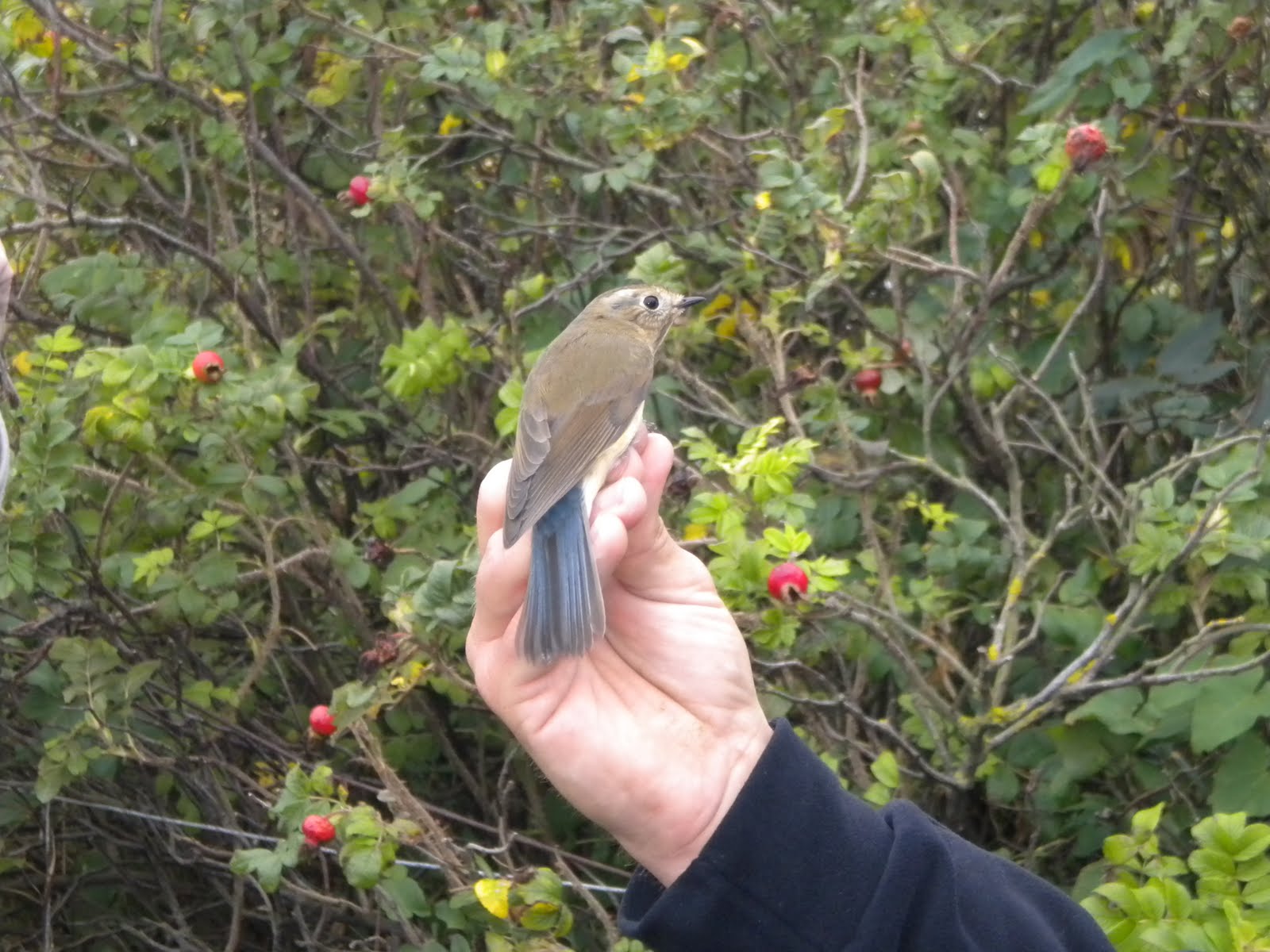
Red-flanked Bluetail IN HAND PICTURES & VIDEO!!!

Check out these awesome pictures of Ade's Red-flanked Bluetail caught today at Whitburn, County Durham. Full details and a write up with additional pictures on the Souter Bird Observatory blog. Photos kindly supplied by, and reproduced with permission from Paul Hindess.


Red-flanked Bluetail © Paul Hindess 2011


Red-flanked Bluetail © Paul Hindess 2011


Red-flanked Bluetail © Paul Hindess 2011


Red-flanked Bluetail © Paul Hindess 2011

Also check out Pauls video of the bird in the hand here, gives a really good impression of the bird

Red-flanked Bluetail Whitburn & Flamborough

Just got a call from my mate Ade (Souter Bird Obs) saying he's just caught a Red-flanked Bluetail at Whitburn. Will be released at 1245. Pictures to follow i'm sure...

As far as I know this is the first Red-flanked Bluetail of the Autum in the UK and it will be interesting to see how many more turn up in the coming days!

Ade is mega jammy, this is the second one he's caught at Whitburn in the last few years after he caught one in 2009 which I think was the last accepted record in County Durham. Hopefully this one will perform a bit better that the last one to visiting birders!!!

There is also another bird at Whitburn, in the village.

UPDATE

Just seen on facebook that a Red-flanked Bluetail has also just been ringed at Flamborough too! Holmes Gutt, thats where I'd be birding today if I wasn't writing my report!

There is also another bird in Suffolk at Orford Ness.

Wednesday, 12 October 2011

Arctic Skua in Derbyshire a Status Update

Had an email today from the Derbyshire County Bird Recorder giving me some information on the status of Arctic Skua in the county:

"This would be the second record so far this year after a juvenile at Carsington Water found late evening on 24th September and still present up to 6.45 a.m. next morning before it flew off NE.

There have been a total of 35 records since the formation of the Derbyshire Ornithological Society in 1954 with the last record being in 2007 at Ogston Reservoir, a dark phase bird briefly on 27th May. Previous to 1954 there were 9 earlier records.

It is still the most commonly occurring Skua in Derbyshire but because of it’s less than annual showing it is a species which is on our list of Rare and Scarce birds which requires a description to back it up before it becomes part of our “official” records."


In summary it appears as though my record is the 45th record of Arctic Skua in Derbyshire which is quite cool!

Tuesday, 11 October 2011

Redwings Back

No birding for me the last couple of days however I have had my first Redwing of the autumn back over the garden yesterday. Lapwing, Golden Plover, Geese and Gull numbers all seem to be increasing rapidly so hopefully I'll get chance to grill them in the coming days and weeks for something good amongst them. Not seen any more Yellow-legged Gulls recently.

'My' House Martins successfully fledged a couple of chicks at (presumably) their second attempt which was very pleasing. It was not particularly nice finding a pile of dead chicks under their nest at their first attempt. Most of the local House Martins seem to have departed however there are still a fair few around. Swallows too are decreasing however dawn and dusk seems to see a decent number as they arrive to, or depart from their roost in the maize crop.

Last week I saw two Hobbies, 1 down in mid-Lincs, the other just down the road in Escrick, probably my last ones for the year I'd guess, unless I get one on the Scillies next week....

Monday, 10 October 2011

Rock Thrush sp North Norfolk

Blue Rock Thrush or Rock Thrush in Norfolk?

News this morning of a possible interesting thrush sp in Norfolk. Could this be Rock Thrush or an eastern form of Blue Rock Thrush and if so a wild bird or an escapee?? Hopefully we will see some pictures if it is re-found...

For those who don't know about Blue Rock Thrushes here is some info from Wikipedia...

The Blue Rock Thrush or Blue Rock-Thrush (Monticola solitarius) is a species of chat. This thrush-like Old World flycatcher was formerly placed in the family Turdidae.

This species breeds in southern Europe and northwest Africa, and from central Asia to northern China and Malaysia.


Blue Rock Thrush Monticola solitarius

The European, north African and southeast Asian birds are mainly resident, apart from altitudinal movements. Other Asian populations are more migratory, wintering in sub-Saharan Africa, India and southeast Asia. This bird is a very uncommon visitor to northern and western Europe.


Blue Rock Thrush Monticola solitarius philippensis

Blue Rock Thrush breeds in open mountainous areas, usually higher than the breeding zone of the related Rufous-tailed Rock Thrush. It nests in rock cavities and walls, and usually lays 3-5 eggs. An omnivore, the Blue Rock Thrush eats a wide variety of insects and small reptiles in addition to berries and seeds.


Rufous-tailed Rock Thrush

This is a starling-sized bird, 21–23 cm in length with a long slim bill. The summer male is unmistakable, with all blue-grey plumage apart from its darker wings. Females and immatures are much less striking, with dark brown upperparts, and paler brown scaly underparts. Both sexes lack the reddish outer tail feathers of Rock Thrush.

The male Blue Rock Thrush sings a clear, melodious call that is similar to, but louder than the call of the Rock Thrush.

Or, what about an escapee Superb Starling?


Superb Starling fairly common in captivity

Thursday, 6 October 2011

Arctic Skua in DERBYSHIRE

I was out surveying at a secret location in central Derbyshire today in gale force winds. I've not been to this site since about February when I was getting some amazing views of Peregrine Falcon.

Today was no exception with excellent prolonged views of the pair of adults performing aerial displays and hunting a mix of Feral and Wood Pigeons, often giving really close views, however the main interest came at about 1.30pm when a shape caught my eye as it headed east on the gale force winds, a quick look with my bins made me do a double-take, SKUA! I quickly got on it with my scope and there it was, an adult pale-phase Arctic Skua, complete with long tail streamers. As it flew right over my vantage point it gave spectacular views. Its flight was jerky as it moved up and down in the wind, occasionally it circled up high but it also dropped really low several times as it went on its way. I watched it for about 3 km as it flew away and out of sight. A VP tick for me!


I'm not sure how many annual records there are of Arctic Skua in Derbyshire, though I guess most of them are from Carsington Water or Ogston Reservoir, in fact a quick search of Birdguides reveals:

A juvenile at Carsington Water on the 24th/25th September 2011 with one on 5th November 2007, one on 27th May 2007 and a probable 26th October 2002 Ogston reservoir with a juvenile over Pleasley Pit CP on 8th August 2005.

However I guess this is not all of the records. I have some recent Derbyshire Bird Reports in the office so will check this out tomorrow.

My location was approximately 110 km (70 miles) from the west coast with the east coast being a further 135 km (83 miles) away, so pretty much as inland UK as you can get!!! Though I guess a cross-country flight of approximately 250 km (150 miles) is not huge for a bird such as this!

Certainly a memorable day!

Wednesday, 5 October 2011

Northern Waterthrush Stop Press Photos

Check out the incredible photos of the Northern Waterthrush by Andrew Vinson below. I was stood next to Andrew as he was taking these, what a sight! All images are reproduced with permission.


Northern Waterthrush © Andrew Vinson 2011


Northern Waterthrush © Andrew Vinson 2011


Northern Waterthrush © Andrew Vinson 2011


Northern Waterthrush © Andrew Vinson 2011

Tuesday, 4 October 2011

Solitary Sandpiper - Cracking set of pictures

At Lands End airport the other week Dave and I met a guy called Andrew Vinson who, like us was heading over to The Scillies in order to try and catch up with the Northern Waterthrush, while there he captured some great shots of it, and also the Solitary Sandpiper, Red-eyed Vireo and Pectoral Sandpiper. The Solitary Sandpiper shots are reproduced with permission below. All images are copyright Andrew Vinson. This wonderful set of pictures allow pretty much all of the key ID features to be seen.


Solitary Sandpiper © Andrew Vinson 2011


Solitary Sandpiper © Andrew Vinson 2011


Solitary Sandpiper © Andrew Vinson 2011


Solitary Sandpiper © Andrew Vinson 2011

I will put some of the Northern Waterthrush, Pectoral Sandpiper and Red-eyed Vireo shots up shortly.

Saturday, 1 October 2011

More on Scillies

As a follow-up to my last post I thought I'd look into the rarity status of two of the rarer birds I'd seen on the Scillies. I'd usually check out Slack (2009) Rare Birds Where and When Volume 1 before the event but due to my high workload prior to going down there I didn't get the chance.

Northern Waterthrush was probably bird of the trip. It's always nice to get an American vagrant, but so much sweeter when it's a passerine. I was a bit gutted not to get the Black-and-white Warbler but statistically the Waterthrush is the rarer bird. There has been 15 previous records of B&W Warbler in the UK, with only 8 records of the Waterthrush.

There is a definite bias for the Scillies with four previous records (2x St Agnes 1958 and 1989, 1x Tresco 1968 and 1x Bryher 1982) all occurring. Other UK records include County Cork (1983 and 2008), Lincolnshire 1988 and Dorset 1996. Interestingly this morning the bird on the Scillies was caught and ringed. Check out the incredible picture below from Ashley Fisher and the Scilly Pelagics Website for more pictures and a video.


There has been approximately 35-40 Solitary Sandpiper records with approximately 25% of these occurring on the Scillies with the vast majority of others either in Cornwall or on various Scottish Islands. No doubt there will be a full and detailed account within Volume 2 of Rare Birds Where and When. Scillies certainly seems to be the best place to connect with this transatlantic vagrant.