Friday, 6 January 2012

Ubatuba: Brazil Birding Tour

Bird Race on Sunday, looking forward to that...in the meantime I've spent the last week working on putting together a birding tour to Brazil for Tico Tours. I'll post details of the full itinerary soon but in the meantime check out some of the images below from the area of main focus, Ubatuba.

Ubatuba sits on the coast in the northeast corner of Sao Paulo, Brazil, of the areas 711 square Kms, 83% is within the Serra do Mar State Park which therefore makes it an important area of contiguous forest where many endemic animals and plants thrive. The coastal stretch is one of the most beautiful in the country, (with over 80 beaches) and the area is also famed for the Atlantic Rainforest, which includes restingas and mangroves, lowland and interior forest and high altitude pastures, each with its own myriad of species. All of the various habitats outlined above result in a bird list in the region of almost 500 species! This tour will focus on the range of habitats available in the region with the focus on connecting with as many as possible, as well as learning about some of these fascinating species.


Brazilian Tanager - It has to be one of the Atlantic Rainforests most spectacular of endemic birds © Elsie Laura


Brazilian Ruby © Elsie Laura


Golden-rumped Euphonia © Elsie Laura


Green-headed Tanager - One of the most beautiful birds around © Elsie Laura


Red-necked Tanager © Elsie Laura


Saw-billed Hermit © Elsie Laura


Black-capped Foliage-Gleaner © Elsie Laura


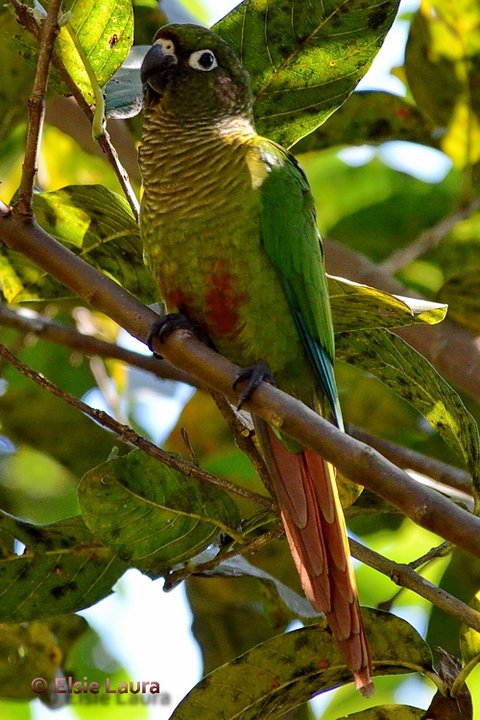
Maroon-bellied Parakeet © Elsie Laura


White-bearded Manakin © Elsie Laura


Yellow-fronted Woodpecker © Elsie Laura

For many more incredible images check out the Tico Tours facebook page.

Sunday, 1 January 2012

Review of 2011: WARNING: This report contains some AWESOME birds!

This will be a brief review of 2011, in what was a pretty cool birding year for me both at work and for pleasure both home and abroad. Some of the photos are mine, and others are not – it will be clear which are which! It was good to meet up with old birding friends, and make some new one too - some of their work is included in this report. If you click on some of the bird names etc it will direct you to the relevant page with more details.

The year got going with Rufous Turtle Dove, Ross’ Goose, Rough-legged Buzzard and Arctic Redpoll all in the first few weeks of the year and local interest in the form of a wintering Great Grey Shrike, several Common Crane and Glaucous Gull along with huge numbers of wildfowl such as Whooper Swans and a range of geese and raptors. Work ‘ticks’ during this period included a single Tundra Bean Goose on one of my sites.


Rufous Turtle Dove © Bob Duckhouse 2011.

Spring and Summer were busy with work, mainly report writing but I managed to get some decent surveying in, resulting in breeding Nightjar, Merlin, Short-eared Owl, Peregrine, plenty of Quail (one site with c.20 singing birds!) and a plethora of Little Ringed Plover too across several of my sites, along with a decent range of scarce breeders too. Rarity highlight during the period included the famous White-throated Robin – seen down to a few metres in the Doctors garden and a local Marsh Sandpiper. A Quail singing and audible from my house was a nice surprise!


White-throated Robin off my phone.

It was at this time, late spring, that Jenny and I took a very successful trip over to Cyprus resulting in a number of new birds (Cyprus Warbler, Cyprus Wheatear, Chukar, Cretzschmar’s Bunting), some incredible avian spectacles (e.g. thousands of migrating swifts, daily totals of three/four figure bee-eaters flocks, dozens of golden orioles, red-backed shrikes, breeding Rollers and Bonelli’s Eagles, singing Masked Shrike and tonnes of Eleonoras Falcons etc), lots of endemic sub-species (future armchair ticks) and even a national rarity, Little Swift! This was a truly brilliant location – trip report starts here and trip list here.


Bee-eater (© Mike Bowman 2011)


Masked Shrike singing (© Mike Bowman 2011)


Eleonora's Falcon (© Mike Bowman 2011)

Autumn started early, and lasted a long while, and was amazing, bordering on insane! Yellow-legged gulls started building up in a local field on my dog-walking circuit, peaking at at least 10 birds. A trip to Lincolnshire resulted in a very confiding American Black Tern and a couple of Red-necked Grebe that had an air of holboellii about them. In September things started to kick off down on the Scillies so I thought it only polite to partake in some of the riches and dragged Dave down there twice (September 23rd – 26th and October 17th – 22nd) kicking and screaming all the way...


American Black Tern (© Robert Hardy 2011)

Highlights from these trips included: Northern Waterthrush, Scarlet Tanager, Upland Sandpiper, Solitary Sandpiper, Wilson’s Snipe, Red-eyed Vireo (1 re-found), Olive-backed Pipit (2), Lesser Yellowlegs (1 self-found), Pectoral Sandpiper (3/4), Melodious Warbler, Icterine Warbler, Black Kite, Wryneck (1 self-sound), Ortolan Bunting, Yellow-browed Warbler (loads + self-found), Woodchat Shrike, White-spotted Bluethroat, Richard’s Pipit (1 self-found), Red-throated Pipit (1 or 2, 1 self-found), Water Pipit (1 self-found), Buff-breasted Sandpiper (2 – 1 self-found), Firecrest (dozens + self-found), Siberian Chiffchaff (1 self-found), Balearic Shearwater (6), Leach’s Petrel (2), Sabine’s Gull (1) and several Black Redstart. Good Scillies birds, but hardly awe-inspiring included Treecreeper, Mistle Thrush and Pink-footed Goose! Several Cirl Bunting and Chough were enjoyed en-route.


Solitary Sandpiper © Andrew Vinson 2011


Northern Waterthrush © Andrew Vinson 2011


Upland Sandpiper - off my mobile phone


Wilson's Snipe - off my mobile phone


Olive-backed Pipit - off my mobile phone

I’d have been happy with the above, the autumn on the east coast had been rubbish until early November, when it finally kicked off, allowing me to catch up with Isabelline Wheatear, Greater Yellowlegs and Eastern Black Redstart. Thinking that my luck was in I ventured down for the Western Sandpiper and connected with that too. Another great set of birds, though I did chicken out of the Veery twitch (and would have connected in hindsight)!


Isabelline Wheatear - off my phone


Greater Yellowlegs, Hauxley NR © Frank Golding 2011.


Eastern Black Redstart, Holy Island © Tristan Reid


The one that got away....Veery © Stephen MacDonald 2011

Work was also enjoyable during the Autumn and Winter period with three sites in particular being very good, resulting in up to approximately 10 Hen Harriers being seen as well as dozens of Marsh Harrier, 5/6 Short-eared Owl, regular Merlin and Peregrine, some more Tundra Bean Geese, and a (very) in land "paradoxus" Black Redstart. Two other ‘work ticks’ in the form of a very showy Rough-legged Buzzard and a Rustic Bunting in November and December finished off the year nicely! As did Peregrine and Woodcock over my office in York city centre.

Looking forward to what 2012 will bring, a trip to the Pyrenees is on the cards which will hopefully result in one of my top 10 most wanted birds – Lammergeier, and who knows what else, hopefully a few more UK ticks too... Looking forward to it... Good birding.


Lammergeier © Nature Photography UK


Lammergeier © Nature Photography UK

Friday, 30 December 2011

Peregrine Rage!

I did a day surveying today as I took a day off last week instead of working in order to prep for Christmas. The weather was perfect today, cold but still and dry. There was tonnes of Golden Plover activity today with thousands of birds about the place however the highlight was a frustratingly brief view of a Christmas cracker adult male Hen Harrier - stunner.

The real highlight came in the last 5 minutes of my 2011 surveys, I picked up on a female Peregrine shooting towards me, then heard a scream and looked around to see two smaller falcons tanking low along the ground in the same directions, a little confusion: male Peregrine chasing female kestrel or merlin? bins up, BASH adult male ripping into a juvenile male Peregrine!!! They were so loud and certainly not happy about seeing each other! As they shot about high then low constantly at each other the female carried on through keeping an eye on proceedings. They eventually went out of my sight but what a way to end my 2011 surveys! Total Peregrine Rage!

Wednesday, 28 December 2011

Cotingas and Manakins - A book Review

I was very lucky this Christmas to get a couple of really good books. One of which was Cotingas and Manakins by Guy Kirwan and Graeme Green (Helm Identification Guide Series 2011). Illustrated by Eustace Barnes.

This is a mammoth Helm Guide and follows on from some really strong books that I love such as Sylvia Warblers and Gulls of Europe, Asia and North America. I've just started to work through the book - at 640+ pages crammed with data it will take a while. I've been lucky enough to have seen several species in the book through plenty of time spent in Costa Rica, Panama and Trinidad and Tobago such as the impressive Long-tailed Manakin, Snowy Cotinga and Bare-necked Umbrellabird, the mythical Sharpbill, Grey-headed Piprities and Thrushlike Shiffornis to name a few...


The front cover featuring amazing artwork of Guianan Cock-of-the-Rock by Eustace Barnes.

The New World tropics possess the richest avifauna on Earth, with more than 4000 recorded species, many of which are endemic. Two groups found exclusively in this region are the Cotingas and the Manakins. Few other families of birds have such widespread appeal; they are much sought-after by birdwatchers for their colourful displays, unusual plumages and, in some cases, great rarity. For scientists, their natural history and behaviour provide fascinating case studies that yield important data in the quest to understand evolutionary biology, while, for taxonomists, elucidating their relationships has proved at times fascinatingly elusive, with many novel and unusual developments.

Two decades ago the species covered in this book were generally considered to comprise two families, but ongoing molecular work has revealed much about the relationships of these birds. One new family has been erected (the Tityridae) and another more widely recognised (Oxyruncidae). These and other resuls spawned principally by genetic research mean that this diverse assemblage of species is now considered to belong to at least five different families.

This book represents the definitive work on these jewels of the Neotropics, looking in detail at more than l30 species. These range from some of the rarest and most enigmatic birds in the world to some of the best-studied of all tropical species; many are breathtakingly colourful and ornate, but some are dowdy and difficult to see. The authors have lent heavily on the published literature, but have also included many personal, previously unpublished data, based on both field and museum studies. The texts are supported by 34 colour plates by Eustace Barnes, who has also observed many of the species in the field, as well as by detailed distribution maps and approximately 400 stunning photographs that cover all but a tiny handful of species. Some samples pages of the book are shown below.

After a few days of flicking through this books it has done three things:

1) Reminded me of some of the awesome birds I've seen;
2) Reminded me why I love and want to go back to the Neotropics again. Soon! and,
3) Reminded me of some of the awesome birds I've not seen yet... I want Araripe Manakin and some Cock-of-the-Rock action!

This is an excellent read and certainly well worth getting a copy if you have any interest in this group of birds or in Neotropical birding. I'm glad I've got a couple more days off work as I'm struggling to put it down!


Plate 15: Sharpbill, Scaled Fruiteater and Elegant Mourner.


Plate 28: Capuchinbird and Crimson Fruitcrow.


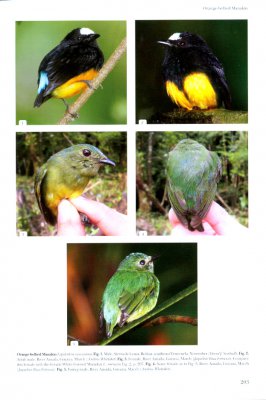
Orange-bellied Manakin text and map page.


Orange-bellied Manakin photo page.


Banded Cotinga photo page.

Tuesday, 27 December 2011

A morning walk around Skipwith

Yesterday (Boxing Day) we all went for a walk around Skipwith, taking in the periphery of the Common and some nice farmland to the north. We went on a route that I've not been on before which was interesting to see.

There was a decent tit flock near where we parked the car, lots of Great, Blue and Coal Tit with a couple of Treecreeper all showing well. There was a sizeable flock of Chaffinch too and a nice mix of Thrushes: Song, Mistle, Blackbird, Fieldfare and Redwing all showing well to close range. A couple of Great Spotted Woodpecker were vocal too as they called from the tree-tops. A small patch of hedgerow held a dozen Tree Sparrow, several Reed Bunting and a couple of Yellowhammer. The usual Dunncok, Robin and Wrens were all busy in the hedge bottoms. There was quite a few Red-legs and Pheasants keeping low trying to avoid the Boxing Day guns and raptors on show included a couple of Kestrels and a few Sparrowhawk.

As we were at the stables in Escrick checking on Jennys horse a Peregrine showed well as it flew low overhead before stooping down behind a copse flushing several dozen Wood Pigeon.

Saturday, 24 December 2011

Lesser Canada Goose - North Duffield...

I popped down to North Duffield briefly this evening with my Dad to try and look for Barn Owls and seeing what else was down there. Unfortunately we didn't see any owls but there was a brief show from a couple of Peregrines, a party of 4 Buzzards were up in the air together and a Kestrel and Sparrowhawk were knocking about too.

Wigeon and Teal were vocal and a few were flying about too. Highlight however was this flock of Lesser Canada Geese, about half a dozen, not sure where they've come from... sorry about quality of pic, taken on phone in almost darkness!


By the way Happy Christmas to everyone! When I'm off during the week I'll write my review of the year - for what has been a very successful year (unless I'm out birding again!)

PS - Don't worry the geese are decoys, but they got me excited for a few moments until I saw the guy in the bushes with his AK!

Thursday, 22 December 2011

Interesting insight into Honey-Buzzard breeding bahaviour

Found the following interesting report today: Camcorder to rescue as Honey Buzzards spread their wings:

Bird experts have unveiled their latest weapon in a bid to shed light on the secret life of the elusive honey buzzard – a camcorder.


The striking face of a honey buzzard snapped on its visit to South Wales.

The tree-mounted camcorder was moved between carefully selected sites by Forestry Commission Wales to track the movements and habits of the rare bird of prey – so-called because of its unique diet.

Along with honey buzzard expert Steve Roberts, Forestry Commission Wales has been studying the birds for a number of years with the help of a static nest camera to record their annual visits to the forests of South Wales.

The camera provided important information on the birds’ breeding habits, but proved to be less successful over the past few seasons as the birds used other nest sites to breed.

Forestry Commission Wales Conservation and Heritage Manager Rosalind Codd said, “Birds can change nest locations each breeding season and a camcorder is useful for recording previously ringed birds, for example, as it can be moved between nests".

“The mobile nest camera project proved very successful in its first year, with a number of active nests found and filmed in detail by Steve".

“Footage such as hunting patterns, nest building, feeding behaviour, growth and activity of chicks was recorded, and we were able to begin identifying individual birds in each nest.”

Honey buzzards build their nests on branches of large trees and are usually found in areas where there are big mature forests, such as those in South Wales, but the exact location of their nests is closely guarded because of the threat from egg collectors.

The birds arrive from their wintering grounds in equatorial Africa in mid-May and the adults fly non-stop back to Africa in September. Migrating birds have been tracked using satellite transmitters funded by Forestry Commission Scotland, which also demonstrated the vulnerability of young birds on their first migrations.

The honey buzzard population is stable through most of Europe but is a rare breeder in the UK. It’s not known how many there in Wales, partly due to the inconspicuous nature of the bird.

Forestry Commission Wales has also been funding the ringing of a number of chicks which could be identified by the camcorder to establish their age and determine the range that birds are prepared to travel to find a mate and establish new nest sites.

Rosalind said, “We are very privileged to have these rare birds breeding in South Wales and it’s great to be involved in such an important project".

“The results will prove invaluable in helping to understand these secretive birds and to gain a better idea of their habitat requirements. This will help us to make informed management decisions to enhance such valuable habitats for the future.”

The honey buzzard is best identified by its long head shape and distinctive two or three bars on its tail. It is usually silent, but can make whistling noises near its nest and is sometimes confused with the common buzzard.

Honey buzzards feed mainly on the nests, larvae, pupae and adults of wasps, bees, bumblebees and hornets. The birds follow flying insects to the nest and dig as deep as 40cm with their feet to reach their prey.

It has small, dense, scale-like feathers on the front of its face to help prevent it being stung by its prey, and powerful feet with thick scales and slightly curved claws of almost equal size for digging and walking, as well as slit-like nostrils to reduce soil blockage while digging.

When main prey is scarce, they will eat other insects, amphibians, reptiles, small mammals, nestlings and eggs of birds, worms, fruit and berries. Its peculiar diet is also the reason behind its alternative name of “bee hawk”.

The data from this year’s breeding season will now be collated and Steve will begin to build a data set for the birds breeding in South Wales.

Rosalind added, “We hope the project will continue in future years and, in time, we will get a much better grasp of this elusive bird’s ecology and behaviour.”

Monday, 19 December 2011

So Many Harriers

So far this winter I've seen more Hen Harriers than I can remember, and I'm loving it!

Hen Harriers are such awesome birds, I could watch them for hours and days and not get bored! Good job really as I seem to be having a few on my sites at present which is great fun to be able to watch and study them as they go about their business.

I was at a site in Lincolnshire today that has already turned up some good birds in the few times I've been. Today was no exception with a cracking ring-tail Hen Harrier giving the Linnet flock cause for concern as it flew right past me, followed later on in the day by a cracking adult male that spent some time nearby as it hunted along the various ditches.

Further highlights included a pair of Peregrine almost catching a Pigeon, Water Pipit in a frozen ditch and thousands of Fieldfare with a decent number of Blackbird thrown in. I'll be keeping my eyes on the flock of 50+ Yellowhammer, just in case they are joined by anything a bit rarer....

Thursday, 15 December 2011

Black Redstart: Smart Find!

Yesterday I spent the day in the office, unfortunately no sign of the Peregrine putting the fear of god into the feral pigeons. One of my surveyors dropped me a message saying they'd just found a Great Grey Shrike on one of my sites - a great find. Unfortunately due to the weather forecast we had to move some surveys around for the end of the week which meant I got to drop a day in the office for some winter walkover surveying today.

The forecast for clear sky and sun had me looking forward to a day wandering about in the winter chill in the hope of connecting with something half decent, maybe even a shrike. When I opened the curtains and found a covering of snow and thick mist my expectations for the day soon decreased!

On arrival at the site there was no snow but it was blowing a cold cold wind with the occasional sleet shower but at least the sun was coming out. Unfortunately a flock of geese didn't contain any of the scarcer species that have been relatively abundant this winter.

As I walked around some scrub near a waterbody a few Dunnock and Robin were alarm-calling away (was there a Shrike about?) and then up popped another bird - typically it popped up straight into the sun, I lifted my bins but couldn't quite place it, was there a white patch in the wing? The bird made an unfamiliar clicking sound as it jumped higher into the tree, a flash of red - I wished it would move out of the sun, another 'click' and it flew into the top of a pine tree briefly before dropping down towards the waterbody. I jumped a couple of walls and refound the bird on the waters edge - Black Redstart, and a cracking male - a bit wind blown but a smart bird nevertheless. I'm thinking this is a juvenile male in ‘paradoxus plumage’ - (where it essentially looks similar to an adult male). I got on the radio to inform the other guys out on site and managed to get a record shot (phone-binned) - below. It was interesting seeing the more-typical Black Redstart after seeing the Eastern Black Redstart on Holy Island a couple of weeks back.


Black Redstart(Phone-binned)


Black Redstart(Phone-binned)


Black Redstart(Phone-binned)


Black Redstart(Phone-binned)

The Black Redstart showed well for 10 minutes but then I had to get on my way and continue my survey but it seemed pretty settled as there was plenty of insects about. A little altercation was noted with a Grey Wagtail but it gave as good as it got!

The rest of the survey was pretty uneventful, at least in my zone, however the other guys had some decent birds, highlights included Short-eared Owl, several hundred Common Snipe, 3+ Jack Snipe, Kingfisher and a Peregrine nailing a Common Snipe.

Wednesday, 14 December 2011

Short-eared Owl: Ringing reveals mysterious migration

There appears to be a large number of Short-eared Owls wintering in the UK this year, including some in the York Recording Area. Hopefully I'll catch up with one at North Duffield or somewhere else in the LDV soon. I am getting good views of up to 4 birds on one of my sites which is enjoyable.


Short-eared Owl © Steve Garvie 2009

A new, interesting paper has just been published in Journal of Ornithology - Changing migration patterns of the Short-eared Owl Asio flammeus in Europe: an analysis of ringing recoveries.

Analyses of almost 500 ringing recoveries spanning nearly a century show marked spatial and temporal differences in the migration patterns of Short-eared Owls (Asio flammeus) in Europe. Despite several spectacular sightings in recent months, this species is a candidate for red-listing (based on marked range contractions apparent from the Atlas). Short-eared Owls are known to show considerable annual variation in their “irruptive” migration. However this study has found that the distances travelled increased from the 1920s through to the 1960s and 1970s, but have since fallen. This provides circumstantial evidence about likely population changes (earlier studies by the BTO have shown the problems in trying to survey this species); it is speculated that the increase in migration distance was associated with population growth in the early to mid-20th century, and similarly, that populations have declined since the 1970s. Ringing recoveries also showed that birds hatching or breeding in Scandinavia and Central Europe travelled the furthest on migration, while those from Britain and the low-lying North Sea area made the shortest journeys. A reduced tendency to migrate the greater distances in the latter part of the 20th Century may have contributed to breeding declines in more southern and isolated parts of these birds’ range, where populations could have been compromised without periodic immigration. However, shorter distances between breeding and wintering grounds, especially within Britain and some British island groups, could also be particularly favourable in facilitating the conservation of this vulnerable and globally declining species: management plans are often simpler when targeted at smaller spatial scales.

Read the full paper here.

Tuesday, 13 December 2011

NEW Shocking Persecution in UK

Today I've found out about 2 further cases of some appalling bird persecution that have occurred in the UK this year, in a year that has seen numerous cases of persecution hit the headlines, e.g. here.

Firstly: The case of serial egg-collector Matthew Gonshaw (aged 49) of Cherrywood Close, Bow in East London who has extended his infamy as Britain's most imprisoned egg collector. He has been sentenced to yet another jail term, for six months, following conviction for stealing and possessing wild birds' eggs, including those of some of the rarest and most threatened birds in the UK.


Press Association


Watch out for this guy on your local patch - and then phone the police, or maybe some other birders...
Press Association

Gonshaw's home in East London was raided by officers from the Metropolitan Police and RSPB Investigations unit on 2nd June this year. Nearly 700 eggs were found at the premises.

Gonshaw faced 10 charges, including taking five Golden Eagle eggs and 12 Avocet eggs from the wild, and possessing eggs from specially protected species, including seven Golden Eagle eggs, eight Osprey eggs, 12 Avocet eggs, three Peregrine eggs, three Red Kite eggs, and 12 eggs of other specially protected species. The remaining wild birds' eggs were all illegally held but were from species not covered by Schedule 1 of the Wildlife and Countryside Act 1981.


Eggs seized Press Association


More Eggs seized Press Association


Avocet Eggs Press Association

Becky Owen, reviewing lawyer for the Crown Prosecution Service in London, said: "We have worked closely with the RSPB and the Met Police Wildlife Crime Unit to secure this conviction and our hope is it sends out a strong message about the seriousness of these crimes. Matthew Gonshaw's criminal actions caused untold damage to wildlife in the UK. He has plundered nearly 700 eggs, including some from endangered species such as Golden Eagles and Ospreys."

This is his fifth conviction relating to his collection.

In April 2001, he was caught raiding a golden eagle's nest in the outer Hebrides and fined £500. In 2002, he received a three-month sentence for stealing rare British species of eggs, but officers were unable to find his collection. In 2004, he was jailed for four months and fined £5,000 in Scotland for taking eggs and he was jailed again for six months in 2005 after being caught with more than 700 eggs.

I would hope the court has set this guys prison sentence to cover the 6 month breeding season, he obviously likes two things: 1) Collecting birds eggs and 2) Spending time in a cell. A bit of advice for Mr Gonshaw - don't drop the soap.

Secondly: The hunting of wild birds in Malta and Cyprus is widely reported, though little ever seems to happen to anyone caught doing it, despite so called EU protection for our migratory birds. Last year I read about hunters from these countries catching boats to Egypt to hunt birds over there and today I found out about Maltese hunters that have been coming to the UK to shoot our birds - see press release below:

Three persons were on Monday night apprehended by customs at Malta International Airport in possession of dead protected birds. The three persons were returning from a hunting trip in the UK.

A joint operation between Customs, Administrative Law Enforcement police, MEPA officials and veterinary services officials revealed a number of protected birds including birds of prey concealed in their luggage amongst other legal game.

The birds were protected by international law. The persons in question are expected to be arraigned in court soon.


Dead Peregrine

This news, along with that above totally appall me, and I hope all people involved in birds conservation and birding get together and stop this from happening, whether it is a "gentle word" in the ear of a known egger, or pressure on politicians...

Monday, 12 December 2011

Peregrine: Office tick!

A couple of days back I had my third record of Peregrine over my garden.

Today I was back in the office and a little after 9 am just as I was making a cup of tea Ollie spotted a Peregrine flying low over the York city centre roofs as the feral pigeons went crazy! The bird, a juvenile female gave a couple of passes coming right in front of the window on one occasion! A great addition to my office list! Hopefully the plethora of feral pigeons will encourage it to stay around through the winter as it will make report writing a bit more enjoyable!

Strangely this was not my first Peregrine falcon of the day as whilst sat in the traffic on the York ringroad at the A1079 a male shot through on the hunt for some breakfast...

Sunday, 11 December 2011

Western Sandpiper: Cley, Norfolk (late news!)

A bit late this as I've been a bit busy decorating and stuff but last weekend Dave and I shot down to Norfolk in order to try and connect with the 'peep'.


Not THE "peep", but not far off it © Alan Wilson 2007

We had a fairly uneventful journey on the long and windy road to Cley stuck at 40mph for most of the way, but luckily Dave had brought some decent music to make the time fly by!

It was 'freezing' down there according to some (the cockney element), they should come to Yorkshire if they want to know what cold is like!!! We made our way down to the hides to be greeted with "It was showing (with 7 Dunlin) but was flushed by a Merlin, Sparrowhawk and Marsh Harrier". We waited for a while but there was no sign and it was getting noisier and noisier in there (Why do people feel the need to be so loud in these hides?)

As the crowd was starting to annoy me I went into the next hide, which was deserted - awesome, a whole hide to myself overlooking a massive area, now all I needed to do was find the bird!

After 15 or so minutes of scanning, with only a few Dunlin (but lots of Lapwing, Ruff etc about) and a flock of approximately 60 Snow Bunting flying along the beach in the distance, a Marsh Harrier made its way across the back of the marsh, in doing so it started flushing all of the waterfowl. Birds started to drop in closer to the hide and stick their heads out of the longer grass to keep an eye on the raptor.

A small party of Dunlin landed right in front of the hide, 6 of them, but no American "peep" in amongst them. A bit more scanning and I was onto a small wader walking out of sight along a small channel. That has to be it I thought, it was noticeably small though the fraction of a second view was hardly conclusive. A small group of birders appeared into the hide. A short while later the bird walked into view again. Scope on it, "It's here" I said to the few guys and I called Dave who was in the other hide. Just as it walked out of view again Dave came through, shortly followed by the contents of the other hide and after a short and nervous wait the bird came into view, cue loads more noise as people tried to see it.

The "peep" showed well, quite a distinctive bird, a smart Western Sandpiper. After a while something flushed a few of the waders (the hide noise maybe?) and the Western did a little flight where it landed right in front of another hide with a Dunlin that had appeared from nowhere, cue mass exodus to another hide where the bird showed incredibly well briefly, allowing a full range of diagnostic features to be seen, before being flushed again, this time definitely by the hide noise and then it flew out of sight. It didn't come back during the rest of our stay on the reserve.

A good, yet frustrating day. A good ID challenge (I think the bird had started its time at Cley as a Little Stint, had turned into a Semi-palmated Sandpiper before becoming a Western Sandpiper...), made all the more difficult by the loudness in the hides. Some people need a lesson in hide etiquette...

I didn't manage any photos however here are a few pictures of Western Sandpipers looking a bit smarter than the bird I saw!


Western Sandpiper © Arthur Morris (Birds as Art)


Western Sandpiper © Arthur Morris (Birds as Art)

Saturday, 10 December 2011

Species CAN change...

A study of South American songbirds completed by the Department of Biology at Queen’s University and the Argentine Museum of Natural History, has discovered these birds differ dramatically in colour and song yet show very little genetic differences which indicates they are on the road to becoming a new species.

One of Darwin’s accomplishments was to show that species could change, that they were not the unaltered, immutable products of creation,” says Leonardo Campagna, a Ph.-D biology student at the Argentine Museum of Natural History in Buenos Aires, who studied at Queen’s as part of his thesis. “However it is only now, some 150 years after the publication of his most important work, On the Origin of Species, that we have the tools to begin to truly understand all of the stages that might lead to speciation which is the process by which an ancestral species divides into two or more new species.”

For decades scientists have struggled to understand all of the varied forces that give rise to distinct species. Mr. Campagna and his research team studied a group of nine species of South American seedeaters (finches) to understand when and how they evolved.

The study found differences in male reproductive plumage and in some key aspects of the songs that they use to court females. Now, the group is looking to find the genes that underlie these differences, as these so-called candidate genes may well prove to be responsible for the evolution of a new species. This will allow researchers to gain insights into evolution.

Studies like ours teach us something about what species really are, what processes are involved and what might be lost if these and other species disappear.”

The findings were recently published in Proceedings of The Royal Society.

Friday, 9 December 2011

Garden Peregrine

Spent a couple of hours working at home this morning before heading in to the office. A reward for being sat at my desk at 9am came in the form of a 2nd year male Peregrine that burst out of a clamour of rooks that were scattering left right and center by this lean mean hunting machine. It shot straight over the garden and then over the house. I raced to the bedroom and caught it as it came over the roof before it closed its wings and stooped into the stubble field in front of the house putting up a mass of corvids, pigeons and starlings. With a bit of luck it may even have caught one of the village cats! This is my third garden Peregrine sighting since we moved in, just over 12 months ago, hopefully it will become a regular occurrence during the winter?


What a bird! Peregrine (Source Unknown)